Nagi Lifestyle · Curated stationery & artful goods · Addora customer for 3 months
In just three months on Addora, Nagi's customers who chose Buy Now Ship Later came back more often, bought more and shipped smarter:
- 5.6x lift in repeat purchases
- 3x more orders per customer
- 2.2x higher customer spend
- 48% of customers now choose Addora checkout (up from 16%)
- 3 Orders Per Shipment
"It's been a game-changer for repeat purchases, and we'd absolutely recommend the workflow to other merchants." — Nagi Lifestyle
The brand
Nagi Lifestyle is an online shop for unique stationery, offering a carefully curated selection of Japanese washi tapes, rubber stamps, sticker rolls, and planners. You'll find pieces from illustrators like Kurahashi Rei, Aiko Fukawa, and Yumi Kitagishi, along with finds from small independent studios and Nagi's own original designs.
The team behind Nagi are artists themselves, and they collaborate with emerging artists to turn everyday objects into small, meaningful pieces of art. Whether it's a new tape for your planner spread, a stamp that becomes your signature, or a sticker sheet you're saving for the right page, each order feels a little like a treasure hunt.
Customers clearly agree, Nagi holds a 4.98-star rating from more than 1,160 reviews.
The challenge: buy now or miss out
Stationery drops sell out fast. For Nagi's customers, that created a familiar dilemma. They could wait until the basket was big enough to justify shipping and risk losing the item. Or they could check out an order right away, just to secure one wishlist piece before it disappeared.
Either way, someone lost out. A single sticker sheet or a washi tape doesn't travel well on its own, because shipping can cost more than the item. Customers paid shipping more often than they wanted to, or went without. And customers who asked Nagi to hold orders for them created manual back-and-forth for a small team.
The solution: Buy Now, Ship Later
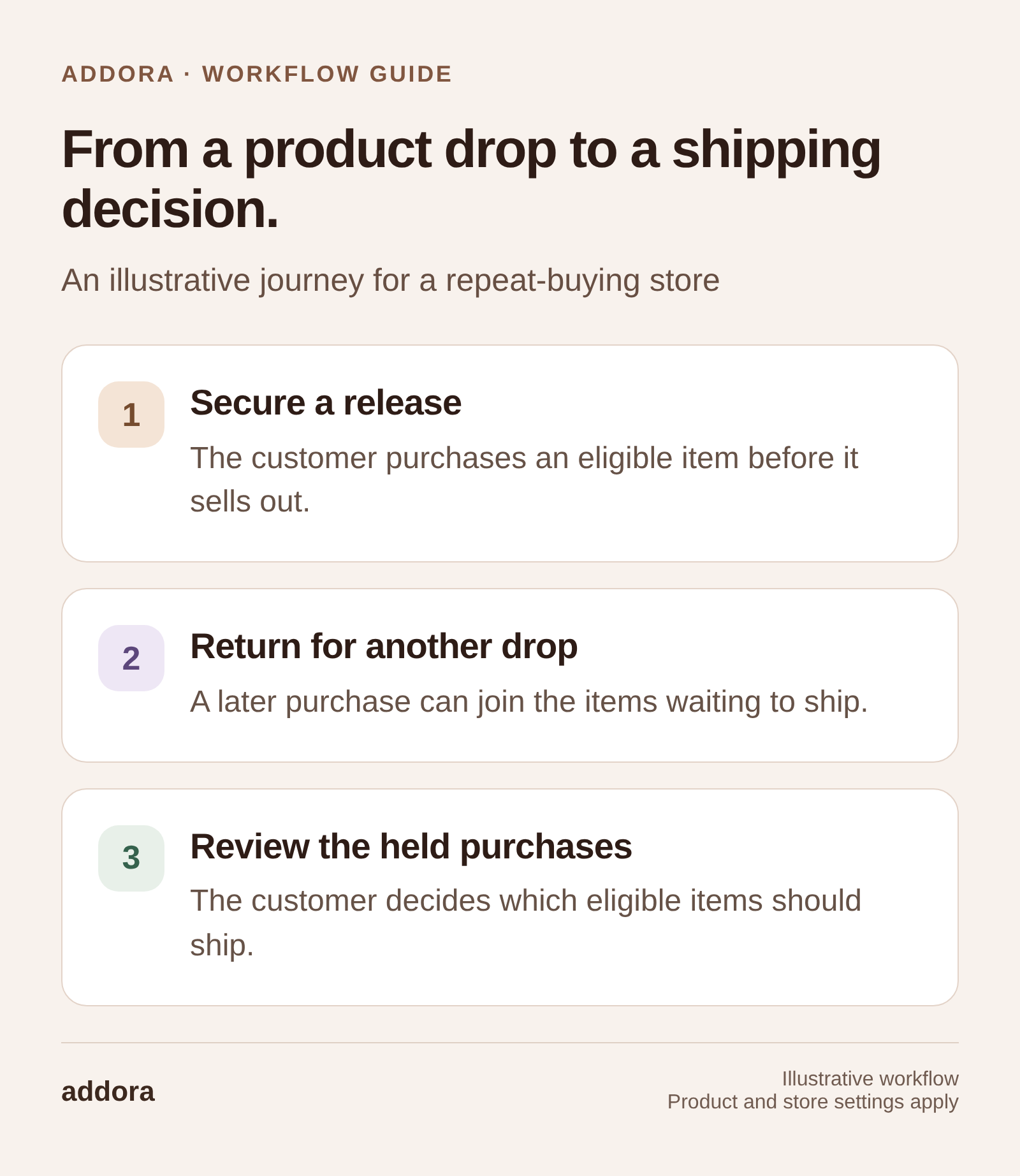
With Addora, Nagi's customers can buy the moment something catches their eye, knowing it's theirs, and choose to hold it. Their next order joins the same box, and everything ships together when they're ready. A new release doesn't need to wait for the next big haul, and a pre-ordered 2027 planner can travel with the tapes and stamps picked up while waiting for it.
Customers can also view and manage their pending orders themselves. There are no emails, no spreadsheets and no manual holds for the Nagi team, because customers self-serve the whole thing at checkout.
Nagi announced the launch to their community on Instagram with their own beautifully illustrated guide explaining how holding orders works.
A feature built for Nagi
Soon after installing, Nagi reached out to Addora support with a request: could they set different shipping conditions for different countries?
At the time, Addora didn’t do that, so we built it.
Addora now supports country-specific shipping rules. Free shipping, or any other adjustment, can apply only to the countries a merchant chooses.
How to set up country-specific shipping rules in Addora:
- Go to Settings → Shipping Rules → Conditions
- Click Add Condition
- Set your rule by price, weight or quantity
- For Adjustment Type, choose Free Shipping (or another adjustment)
- Under Applies to, pick Specific countries and select the countries you want
- Hit Save
You can add country-specific rules on paid plans, creating one rule per country or grouping countries that share the same conditions.
For the reminder workflow described here, read customer email reminders for reserved items. The broader Build a Box guide explains purchases accumulating across visits. The example below illustrates that journey rather than the historical performance figures.
The results
Customers who ship later come back 5.6x more often
Nagi customers who used Addora's checkout made another purchase 84% of the time. That means a genuinely new purchase, not just a return visit to release a held shipment. For customers who didn't use Addora, it was 15%.
3x the orders, 2.2x the spend
Addora checkout customers placed 3x more orders and spent 2.2x more on average than customers who didn't use it. When shipping stops being a penalty on every small purchase, customers stop saving their wishlists for "one big order someday" and buy as they discover.
Adoption tripled in two months
In month one, 16% of Nagi's customers chose Addora checkout. By month three, it was 48%. Nobody was pushed into it. Customers tried it once, saw the savings and kept coming back to it.
Introducing a new metric: Orders Per Shipment (OPS)
Combined shipping is a new concept in ecommerce and a new way to think about fulfillment. To measure its real impact, we're introducing a new metric: Orders Per Shipment (OPS), meaning how many orders, on average, ship together in a single delivery.
OPS = Total Buy Now Ship Later orders per consolidated shipment
Orders per shipment describes how many separate purchases are combined for delivery. It does not mean every ordinary order ships in exactly one parcel, or that other stores never combine orders.
Nagi’s reported average is three purchases per combined shipment. Combining purchases can reduce repeated shipping work; the number of physical parcels depends on how the store fulfills the items.
- 3x fewer shipping fees paid by customers
- 3x fewer labels, parcels and packaging for the Nagi team
- Lower courier costs per order
- 3x fewer support tickets, because one delivery means one tracking number and one conversation instead of three
Repeat purchases show what combined shipping does for revenue. OPS shows what it does for operations.
What customers said
Nagi's launch post filled up with thank-yous. The comments show the problem Buy Now Ship Later solves better than any metric:
"It's always anxious buying a full order just to secure a wishlist item before it's sold out."
"Literally me the other day crying because something sold out haha. This is great!"
"You've taken the stress out of stationery shopping!!"
"Didn't realize we can manage our pending orders too!"
"Now I cannot save money by saying 'it's out of stock' while I wait for new release"
"Awesome… wish u had this last month"
Another customer summed up why it matters for a small business: offering this means holding inventory and absorbing costs that aren't easy to carry. Nagi chose to do it anyway, and the repeat purchase numbers show it paid off.
In their words
"Addora has completely streamlined our held-order and pre-order process. Before, managing shipment holds took a lot of manual back-and-forth, and now it's seamless for both us and our customers. It's been a game-changer for repeat purchases, and we'd absolutely recommend the workflow to other merchants." — Nagi Lifestyle
Visit Nagi: nagilifestyle.com
These results describe the customers and period discussed in this article. They are observed comparisons, rather than a controlled experiment or a guarantee of results for another store.