
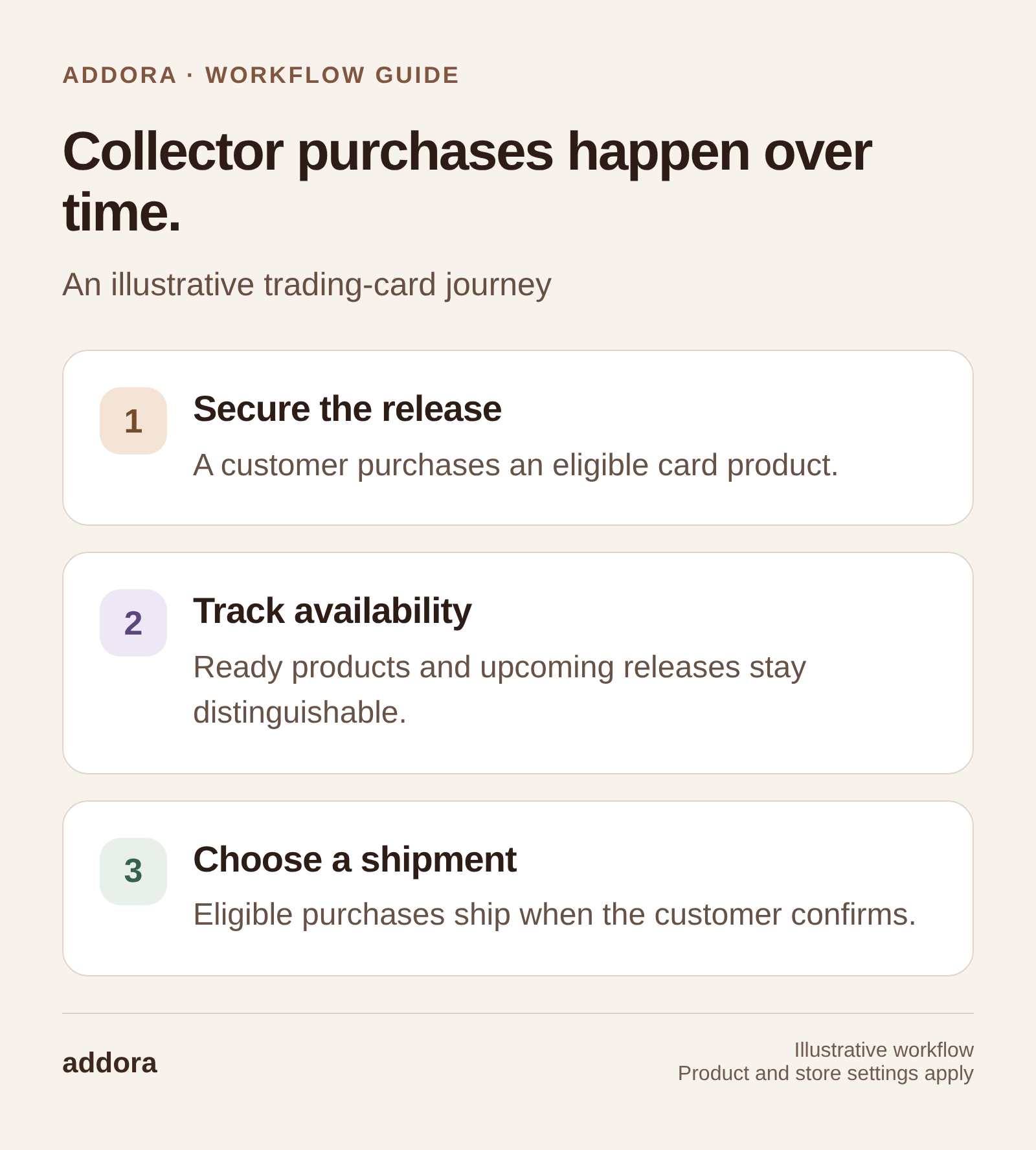
View this workflow at full size
Trading card games are no longer a niche retail category
Trading card games now sit in a much larger commercial and cultural context than many ecommerce stores are designed for. Grand View Research estimates the U.S. trading cards market reached $10.54 billion in 2025, with physical cards still holding the largest share of the market. The same report says younger buyers are entering through digital communities and live card-break culture, while older buyers are coming back through nostalgia and franchise attachment. That matters because it means TCG demand is now driven by both new discovery and returning collectors, not just a stable hobbyist core. (Grand View Research)
At the category level, broader toy and collectible data points in the same direction. Circana says the U.S. toy industry returned to growth in 2025, with total dollar sales up 6% and units up 3%, and specifically called out licensed, collectible, and fandom-led demand as key drivers. Its January to April 2025 update also said toys were the fastest-growing industry it tracked at that point, with growth associated with new Pokémon releases and collectible sports trading cards. (Circana)
That is the first important shift. TCGs should not be treated like a normal catalog category with occasional spikes. They now behave more like a live demand system, where fandom, scarcity, nostalgia, and timing keep buyers engaged continuously. That is a different commerce pattern, and it needs a different checkout logic. (Grand View Research)
Pokémon is the clearest signal of where collector commerce is heading
If you want one franchise that explains the modern TCG market, it is Pokémon.
Reuters reported in 2024 that the Pokémon Trading Card Game had already seen more than 50 billion cards printed. Since then, the commercial footprint has only looked broader. Official Pokémon release schedules show a steady flow of major TCG expansions through January, March, May, July, and November 2025, followed by more major releases in January and March 2026. Pokémon’s own product pages also published monthly roundups for March and April 2026, which reinforces the point that this is not occasional merchandising. It is a recurring release machine that trains customers to come back repeatedly. (Reuters)
The brand has also moved far beyond hobby-shop relevance. UNIQLO promoted its first collaboration with the Pokémon Trading Card Game and Pokémon Trading Card Game Pocket app, showing how the category now crosses over into mainstream apparel and lifestyle retail. When a TCG becomes both a collectible product and a broader brand expression, customer behavior changes with it. People are no longer only buying to play. They are buying to collect, participate, display affiliation, and stay close to the drop cycle. (UNIQLO)
Circana’s 2025 U.S. data makes the scale even clearer. Pokémon became the top toy property in the United States, posting $2.5 billion in sales, up 87% year over year, and helping drive a 37% increase in the Games & Puzzles supercategory. Circana’s own phrasing is telling: “licensed, collectible, and fandom-driven toys” are outperforming. That is not a small niche dynamic. That is mainstream consumer demand organizing itself around fandom and collectibility. (Circana)
The buyer is not behaving like a normal ecommerce shopper
This is where many store operators still underestimate the change.
A collector usually does not think in the tidy retail pattern of “find product, buy product, receive product, done.” A collector thinks in sequences. They want to secure an item before it disappears. They want time to see the next drop. They want to hold off on shipping because they expect to add more. They may be buying for different reasons at once: sealed product, chase cards, grading potential, deck-building, set completion, speculation, nostalgia, or simply fear of missing out on a release window. Much of that behavior is cumulative by nature.
Industry data supports that collector mindset. eBay Australia’s 2025 State of Collectables report estimated 7.6 million Australians, or 35% of the adult population, actively participate in collecting. It found toys were collected by 33% of respondents, trading cards by 16%, and that 35% of respondents viewed collecting as a good investment. In the same report, eBay said collectors are motivated both by love of the item and nostalgia, and one of its category leads said trading cards are “no longer just a childhood pastime.” (eBay Inc.)
Circana’s buyer data points in the same direction. In Q1 2025, adults aged 18+ were the fastest-growing toy demographic, up 12%, and at $1.8 billion they represented the highest spending of any age group. That matters because adult buyers generally have more purchasing power, stronger franchise memory, and more willingness to buy repeatedly across a release cycle. (Circana)
Even sales data from inside the hobby shows that demand is not purely play-driven. TCGplayer’s Q4 2025 and Q1 2026 category summaries said Pokémon’s top-performing cards were mostly collectibles, not just competitively essential cards. In other words, a meaningful share of demand is about ownership and desirability, not immediate gameplay utility. (seller.tcgplayer.com)
The checkout problem is bigger than “shipping is expensive”
This is the part many TCG stores misdiagnose.
The issue is not only that shipping costs money. The deeper issue is that traditional checkout forces the customer to make a final shipping decision too early. For a collector, that is friction. They may be ready to buy the product, but not ready to close the collecting loop.
Baymard’s checkout research is useful here. It says the global average cart abandonment rate is 70.22%. Among shoppers who were not “just browsing,” the most common reason for abandonment was extra costs being too high at 40%, and another 12% said they could not calculate the total order cost up front. Baymard also notes that checkout design itself frequently causes abandonment. (Baymard Institute)
For TCG stores, repeated shipping acts like repeated penalty pricing on enthusiasm. A collector sees a release, buys. Then another release hits a few days later, or a restock appears, or a missing piece for a set becomes available. Now they have to either pay shipping again, wait and risk missing stock, or abandon the purchase. Standard checkout turns that tension into lost revenue. Baymard’s numbers are not TCG-specific, but they explain why this hurts conversion so much: once the customer feels the total cost is misaligned with how they want to buy, they leave. (Baymard Institute)
This is why “free shipping over X” is often not enough for collector stores. It solves a threshold problem. It does not solve a behavior problem. The collector still wants to buy now and decide shipping later.
What Addora changes
Addora is not really a shipping widget. It is a commerce model for stores whose customers buy over time.
Instead of forcing each purchase to become its own shipment event, Addora lets the customer secure the product immediately and postpone the shipping decision. That aligns the store with the actual collector journey:
- buy when the drop happens
- keep adding across time
- consolidate later
- ship once, when it makes sense
That sounds simple, but strategically it is a major change. It removes the false choice between “buy now and overpay on repeated shipping” and “wait, maybe miss the release.” In categories like TCG, where timing is emotional and product windows can move quickly, that matters a lot.
It also lets the merchant benefit from the natural rhythm of collector demand instead of fighting it. If the category is release-driven, fandom-driven, and repeat-purchase-driven, then the checkout should support accumulation, not interrupt it.
Our combined shipping guide covers the shipping decision across purchases. For products that are not yet available, follow the native preorder setup guide so release dates stay distinct from the customer’s choice to wait.
What we are seeing in Addora merchant data
The strongest reason this matters is not theory. It is behavior.
In internal Addora merchant data from trading card stores, we have seen:
- 57.89% of customers choose “ship later”
- roughly 70% of orders come through Addora, representing about two-thirds of total revenue
- repeat customers increase from 30% to 57%
Those are not generic ecommerce benchmarks, and they should not be read that way. They are merchant-level signals. But they line up with the external market evidence surprisingly well.
If collector demand is recurring, then a ship-later option should get meaningful adoption. It does. If customers dislike paying shipping repeatedly, then a consolidated model should capture more orders. It does. If stores make it easier to buy across multiple drops, repeat behavior should rise. It does.
That is why this is more than a conversion tweak. It is a better operating model for the category.
Why this matters strategically for TCG stores
The stores that win in TCG are not just the stores with the best inventory. They are the stores that best match the tempo of collector behavior.
That tempo now looks something like this: franchise momentum, recurring releases, collectors with adult spending power, mainstream brand crossover, digital community hype, and a buyer mindset that is part hobby, part identity, part timing game. Pokémon alone shows nearly all of those conditions at once. (UNIQLO)
So the strategic question for a merchant is not just, “How do I sell the next product?” It is, “How do I become the place where collectors are comfortable buying repeatedly before they are ready to ship?”
That is a different question, and it points to a different stack.
A normal checkout is optimized for transaction completion. A collector checkout needs to be optimized for ongoing participation.
That is the real case for Addora.
Final thought
The TCG market has changed faster than most ecommerce infrastructure has.
Pokémon is now large enough and mainstream enough to make the pattern obvious: this is a category powered by continuous releases, adult collector spending, nostalgia, fandom, and repeated buying opportunities, not single isolated purchases. Standard checkout still assumes the opposite. (Circana)
Stores that keep forcing collector behavior through a one-purchase, one-shipment model will keep creating unnecessary friction. Stores that let customers buy now, build over time, and ship later are much better aligned with how the category actually works.
That is why TCG stores need Addora to keep up with collector behaviour.


