
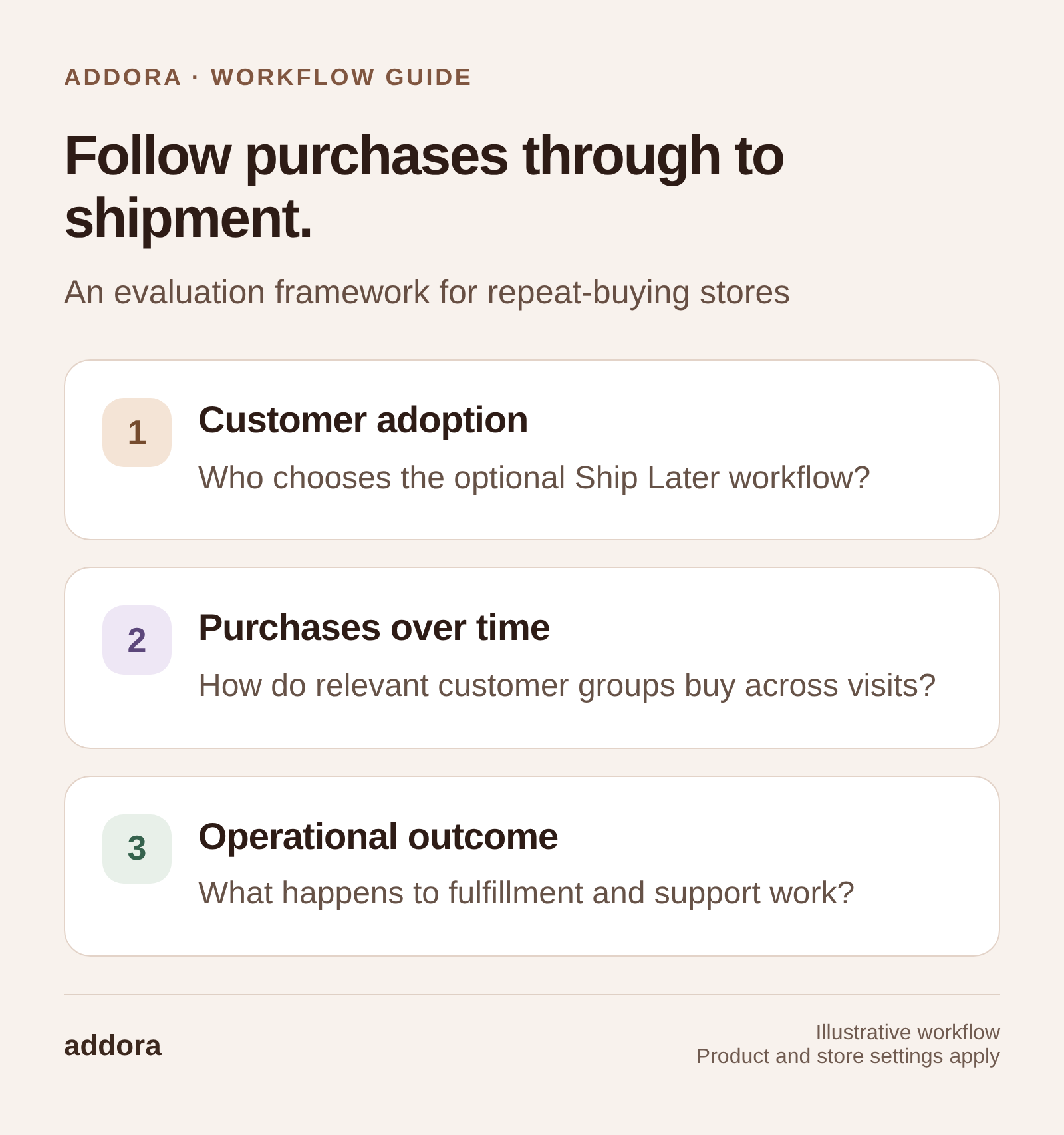
View this workflow at full size
How to read these historical observations
This article describes an earlier observational snapshot of stores using Addora. It is not a controlled experiment, a current benchmark, or a forecast for another store. Customers who choose Ship Later may already be more frequent buyers; differences between groups do not establish that Addora caused additional orders or revenue. Use the figures as historical context and measure adoption, repeat purchases, holding time and fulfillment outcomes in your own store.
For the current product workflow, see Shopify preorders, Ship Later and plans and pricing.
The earlier 30-day collector-commerce observations provide another historical snapshot. Different periods and merchant groups should not be treated as directly comparable experiments.
The Numbers So Far: What Addora Data Is Starting to Show
Looking across the stores using Addora, one trend is becoming clear:
Ship Later adoption continues to grow.
Different categories behave differently, but the overall direction is remarkably consistent. Customers are learning the workflow, using it more often over time, and, in many cases, becoming some of the most valuable customers in the store.
Adoption by Category
Trading Card Games
February to March
- 70% of orders came through Addora
- 57.89% of customers used Ship Later
- Repeat customers grew 2x
April
- 53% of orders were Ship Later orders
- Around 20% of customers used Ship Later
May
- 56.25% of orders came through Addora
- 65.9% of store revenue came through Addora
- Average shipping savings per item: $8.78
Vinyl Stores
February to March
- 30% adoption within one month of installation
April
- 10% of orders were Ship Later
May
- 30% of orders were Ship Later
Comic Book Stores
Month 1
- 3% of orders were Ship Later
Month 2
- 28% of orders were Ship Later
Month 3
- 35% of orders were Ship Later
Month 4
- 38% of orders were Ship Later
- 34% of store revenue came through Addora
- Average shipping savings per item: $5.96
While every category has its own rhythm, the direction is remarkably consistent.
Customers continue adopting Ship Later over time.
And the customers who adopt it often become some of the most valuable customers in the store.
The Revenue Story Is Becoming Clearer
The most interesting metric is not adoption.
It is revenue concentration.
In May, merchants saw:
- 56.25% of orders come through Addora
- 65.9% of total revenue come through Addora
That means Ship Later orders generated a disproportionately large share of revenue compared to traditional checkout orders.
We have seen similar patterns emerge repeatedly.
Customers who adopt consolidation tend to:
- place orders more frequently
- buy opportunistically
- return more often
- spend less time worrying about shipping costs
Instead of asking:
“Do I want to pay shipping again?”
They start asking:
“Do I want to add this to my shipment?”
That subtle shift changes purchasing behaviour dramatically.
The Hidden Cost of Traditional Checkout
Traditional ecommerce assumes every purchase requires an immediate shipping decision.
For many categories, that works perfectly.
But collector categories do not behave like traditional retail.
A comic reader may want multiple weekly releases.
A vinyl collector may wait for several records to become available.
A TCG player may buy singles over multiple days.
Without a consolidation workflow, customers face the same decision repeatedly:
- Pay shipping again
- Delay purchasing
- Abandon the purchase altogether
Many choose the third option.
The result is lost revenue that never appears in analytics dashboards because the customer simply never checks out.
Ship Later changes that equation.
The customer can secure the item immediately while postponing the shipping decision until later.
Vinyl Stores May Be Showing the Strongest Signal
One of the most interesting findings came from vinyl stores.
Within the first month after installation, approximately 30% of orders were already using Ship Later.
Think about what that means.
A customer buying records often discovers products over time.
They may buy one release today, another next week, and a third before dispatch.
The ability to consolidate these purchases into a single shipment aligns almost perfectly with how collectors naturally shop.
Without Addora, many of those purchases would likely be delayed or abandoned due to repeated shipping charges.
The early adoption numbers suggest vinyl buyers understand the value proposition almost immediately.
Comic Books Continue Building Momentum
Comic books tell a different story.
Adoption was not immediate.
It compounded.
Month by month, Ship Later usage grew:
- Month 1: 3%
- Month 2: 28%
- Month 3: 35%
- Month 4: 38%
The growth curve is important.
It suggests customers need time to learn the workflow.
Once they experience it, however, they continue using it.
Comic buying is inherently recurring.
Readers follow ongoing series.
Collectors chase variants.
Customers add back issues unexpectedly.
The more frequently they return to the store, the more valuable consolidation becomes.
By Month 4, over one-third of revenue was already flowing through Addora.
That is no longer a niche workflow.
It is becoming a core purchasing method.
Shipping Savings Are Bigger Than Most Merchants Expect
One metric merchants consistently underestimate is cumulative shipping savings.
In May:
- TCG customers saved an average of $8.78 per item
- Comic customers saved an average of $5.96 per item
Those savings create a powerful incentive to keep using the workflow.
But the merchant benefits too.
Consolidated shipments often mean:
- fewer parcels
- lower fulfilment workload
- reduced packaging costs
- fewer support tickets asking to combine orders
Customers save money.
Merchants operate more efficiently.
The incentives are aligned.
The Bigger Trend Emerging
The longer we analyse Addora data, the more it appears that customers increasingly prefer a different model of ecommerce.
Not this:
Buy → Ship → Repeat
But this:
Buy → Add More → Add More → Ship When Ready
In other words, customers want a running cart.
A digital pull box.
An ongoing collection.
Collector categories are simply showing the trend first because their purchasing behaviour is naturally repetitive and inventory changes constantly.
But the underlying psychology extends much further.
Every time a customer hesitates because of shipping costs, there is an opportunity for a more flexible checkout experience.
What Merchants Should Take Away
The biggest lesson from four months of data is this:
Ship Later is not a shipping feature.
It is a purchasing behaviour.
The strongest-performing merchants are increasingly using Addora as:
- a customer retention tool
- a repeat-purchase driver
- a way to reduce shipping friction
- a method for increasing customer lifetime value
Most ecommerce optimisation focuses on getting customers to buy once.
Ship Later focuses on making it easier for them to buy repeatedly.
And increasingly, the data suggests that is exactly what customers want.
The question may no longer be whether customers want order consolidation.
The question is whether stores can afford not to offer it.
If you want to evaluate a similar buying pattern, our Pile of Loot guide explains purchases accumulating across visits. The customer accounts guide covers how buyers return to those purchases. Treat the figures above as historical observations, not expected results for a new store.
Let Customers Buy Now and Ship Selected Orders Later
Addora helps Shopify stores hold orders, combine repeat purchases, support pre-orders, and collect shipping once when the customer is ready.
Start your free trial today.
These results describe the customers and period discussed in this article. They are observed comparisons, rather than a controlled experiment or a guarantee of results for another store.


