
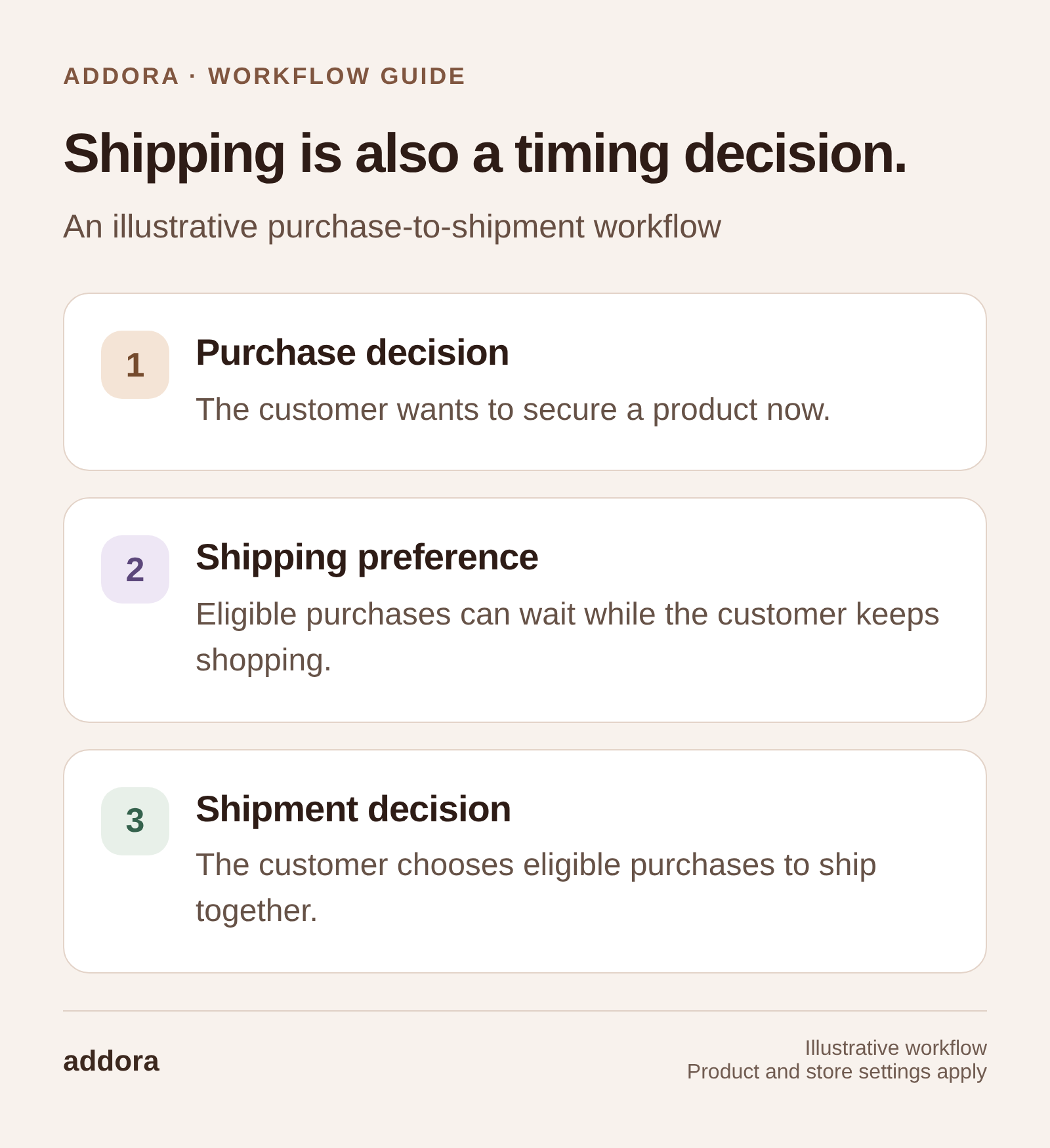
View this workflow at full size
The pattern most Shopify stores recognize
If you have run a Shopify store for more than a few weeks, you have seen this pattern. A customer adds products to cart, gets all the way to checkout, sees the shipping line, and pauses. Sometimes they abandon. Sometimes they come back later. Sometimes they buy, but only once, even though the session showed stronger intent than that outcome suggests.
The broad abandonment numbers are still brutal. Baymard Institute currently puts average documented cart abandonment at 70.22%, and both Baymard and Shopify identify extra costs like shipping, taxes, and fees as one of the biggest reasons customers leave checkout. (Baymard Institute)
Shipping clearly hurts conversion, but that is not the full story
A lot of advice stops at the obvious explanation: shipping is too expensive, so reduce the fee or offer free shipping. That is not wrong. Baymard lists “extra costs too high” at 39% of checkout abandonments, and Shopify says 48% of shoppers abandon because of unexpected additional costs like shipping, taxes, and fees. But Baymard’s data also shows other shipping-adjacent friction points, including delivery being too slow and customers not being able to calculate total cost up front. So even in the raw data, this is already bigger than a simple “price too high” story. (Baymard Institute)
That is the part we think gets explained too simply.
Shipping is not just a fee. It is a commitment moment.
We do not think shipping friction is just about the amount on the checkout page. We think shipping is often the moment where checkout stops feeling flexible and starts feeling final. Up to that point, customers can still browse, compare, collect, and keep options open. Once shipping becomes real, the store is no longer just asking, “Do you want this item?” It is also asking, “Are you done buying now, and are you ready to lock this shipment in?”
That second question is where a lot of otherwise interested customers start hesitating.
Research supports this interpretation
There is good research behind that interpretation. In a widely cited academic paper on cart abandonment, Monika Kukar-Kinney and Angeline Close found that factors related to online search, consideration, and evaluation play a larger role in cart abandonment than factors at the final purchase decision stage. They also found that many customers use carts as entertainment, research, and organizational tools, which can lead to buying later or through another channel. That matters because it tells us the cart is often not a straight line to a purchase. It is a staging area. (Monika Kukar-Kinney and Angeline Close)
Once you see the cart that way, a lot of merchant behavior starts making more sense.
Customers are not always saying “no”
The customer who abandons at shipping is not always saying, “I do not want this.” Sometimes they are saying, “I am not done yet.”
Those are very different problems. One is a demand problem. The other is a timing problem.
This gets worse in stores where people buy over time
That timing problem shows up especially clearly in stores where people naturally buy over time. On our own site, we describe Addora as built for collectors, drops, restocks, pre-orders, and repeat buyers who want to keep adding before they ship. We built Addora around the reality that a normal one-order-one-shipment workflow creates cart abandonment, margin leaks, and too many support questions in exactly those kinds of stores.
Why free shipping only partially fixes it
This is also why free shipping helps, but only partially.
Free shipping absolutely works. Harvard Business School’s Working Knowledge cites research showing that shoppers spent 9.4% more when they needed to meet a free-shipping minimum, although that same shift also led to 6.4% fewer purchases overall. In other words, free shipping thresholds can change basket behavior, but they do not magically remove the friction. They mostly change the economics around the decision. The customer still has to answer the same underlying question: “Is this everything I want right now?” (library.hbs.edu)
For some stores, that question is fine. For others, it is exactly the problem.
Delivery flexibility matters more than many merchants realize
If you sell products that invite repeat buying, new drops, staggered discovery, or accumulation over time, then a customer can have very high product intent while still having low readiness to ship. McKinsey & Company points in the same direction, noting that consumers place importance on flexible delivery options and return policies. That does not automatically mean every customer wants held orders or consolidated shipping, but it does support the broader principle that flexibility in the delivery decision matters. (McKinsey & Company)
That is the pattern we kept coming back to.
Why the usual fixes do not solve the real issue
We looked at the usual merchant fixes. Better shipping messaging. Free shipping thresholds. Earlier price transparency. Manual order combining. Support-based refunds. Telling customers to place everything together in one checkout.
All of those can help around the edges. Baymard and Shopify both support the idea that transparency and clearer pricing reduce avoidable friction. But none of those fixes change the core rule of the standard checkout flow: every successful purchase still ends with a shipping commitment now. (Baymard Institute)
Why we built Addora
That is why we built Addora.
We built it because we do not think the right answer is always “lower shipping” or “more shipping options.” Sometimes the right answer is to decouple buying from shipping timing.
That is the whole shift.
Instead of forcing:
buy now → ship now
we let stores offer something closer to:
buy now → keep buying over time → ship when ready
That is not just a shipping tweak. It is a different purchase model.
How the Addora model works
On Addora, customers can choose Ship Later right at checkout through a branded shipping option, understand what that means before they pay, and keep eligible orders on hold. Then, from a self-serve order summary, they can review pending orders, see box totals, choose which orders to ship together, and trigger one combined shipment checkout when they are ready. On the merchant side, held orders are tagged and visible in Shopify so the workflow stays Shopify-native instead of becoming a support nightmare or a separate operational system your team has to learn.
For a practical example of purchases accumulating over time, read how to build a Pile of Loot. The Shopify customer accounts guide covers the native place buyers can return to review their held purchases.
Why this matters for conversion
That matters for conversion because it changes the shape of the yes.
In a normal checkout, the customer has to say yes to both the product and the shipping timing at the same moment. With a buy now, ship later flow, they can say yes to the purchase while postponing the shipment decision until it actually fits how they buy.
If the real friction in your store is not product demand but premature shipping commitment, that is a much better match for actual customer behavior.
Why this also matters for average order value and repeat buying
It also matters for average order value and repeat purchase behavior. Our Shopify App Store listing describes Addora as a way to let customers place multiple orders over time while shipping stays on hold, then visit the Order Summary page to choose which orders to ship and pay once for one combined delivery. We also support fees, discounts, and free shipping rules by value, weight, and quantity. That means the merchant is not giving up shipping control. They are moving that control into a workflow that fits repeat buying better.
The stores that feel this pain most clearly
The stores that tend to feel this pain most are not hard to spot.
They are the ones where customers naturally think in sequences instead of one-off checkouts. They browse a drop now and another drop next week. They buy one item today, then discover two more tomorrow. They want to build a box, combine limited releases, or hold until they cross a threshold that feels worth shipping.
That is exactly why we talk so much about collectors, restocks, drops, and pre-orders. The standard checkout is too final for how those customers naturally behave.
The real objection is often not the fee
When those customers hit shipping, the issue is often not “I hate this fee.”
It is, “I do not want this session to end yet.”
That distinction is easy to miss, but it changes everything. It explains why some customers abandon even when shipping is not outrageous. It explains why free shipping can help while still leaving a lot of friction behind. It explains why support gets dragged into merging orders, adjusting shipping, refunding duplicate charges, and answering emails that are really just symptoms of a bad purchase flow.
The deeper issue is timing, not just cost
The point is not that shipping cost stops mattering. It clearly matters, and the data on that is overwhelming.
The point is that for some stores, shipping cost is only the visible part of the problem. The deeper issue is that the store forces customers to finalize before they feel done buying. Baymard, Shopify, academic cart research, and delivery-flexibility research all point toward the same broader conclusion: checkout friction is often a mix of cost, uncertainty, evaluation, and timing, not just a single price objection. (Baymard Institute)
The gap Addora is built to solve
That is exactly the gap we built Addora to solve.
We wanted a Shopify-native way for stores to keep the purchase momentum, reduce checkout hesitation, and let customers control when shipping happens instead of forcing that decision too early. So we built a Buy Now, Ship Later flow with self-serve held orders, an order summary page, combined shipment checkout, and configurable shipping logic that works alongside a store’s existing rates.
Our article on cart abandonment and shipping timing explores the same friction earlier in the buying journey.
Final take
If your customers regularly show strong purchase intent but hesitate the moment shipping becomes real, you probably do not just have a shipping-cost problem. You may have a timing problem.
And if that is the pattern, lowering the fee is only one possible answer.
Changing the buying model is often the better one.
Addora is built for exactly that. Merchants can start with a 30-day free trial, then let customers buy now, keep adding over time, and ship when they are actually ready. Get it here.


