
Most people in K-beauty spend a lot of time looking for the next product wave.
The next breakout sunscreen. The next milky toner. The next calming serum. The next lip tint that takes over TikTok for three weeks.
I get why. K-beauty moves fast, and product discovery is a huge part of why customers love it.
But I think the next major shift in K-beauty ecommerce is not going to be an ingredient story. It is going to be an infrastructure story.
It is going to be about how customers shop, how they build a routine, and when they choose to ship.
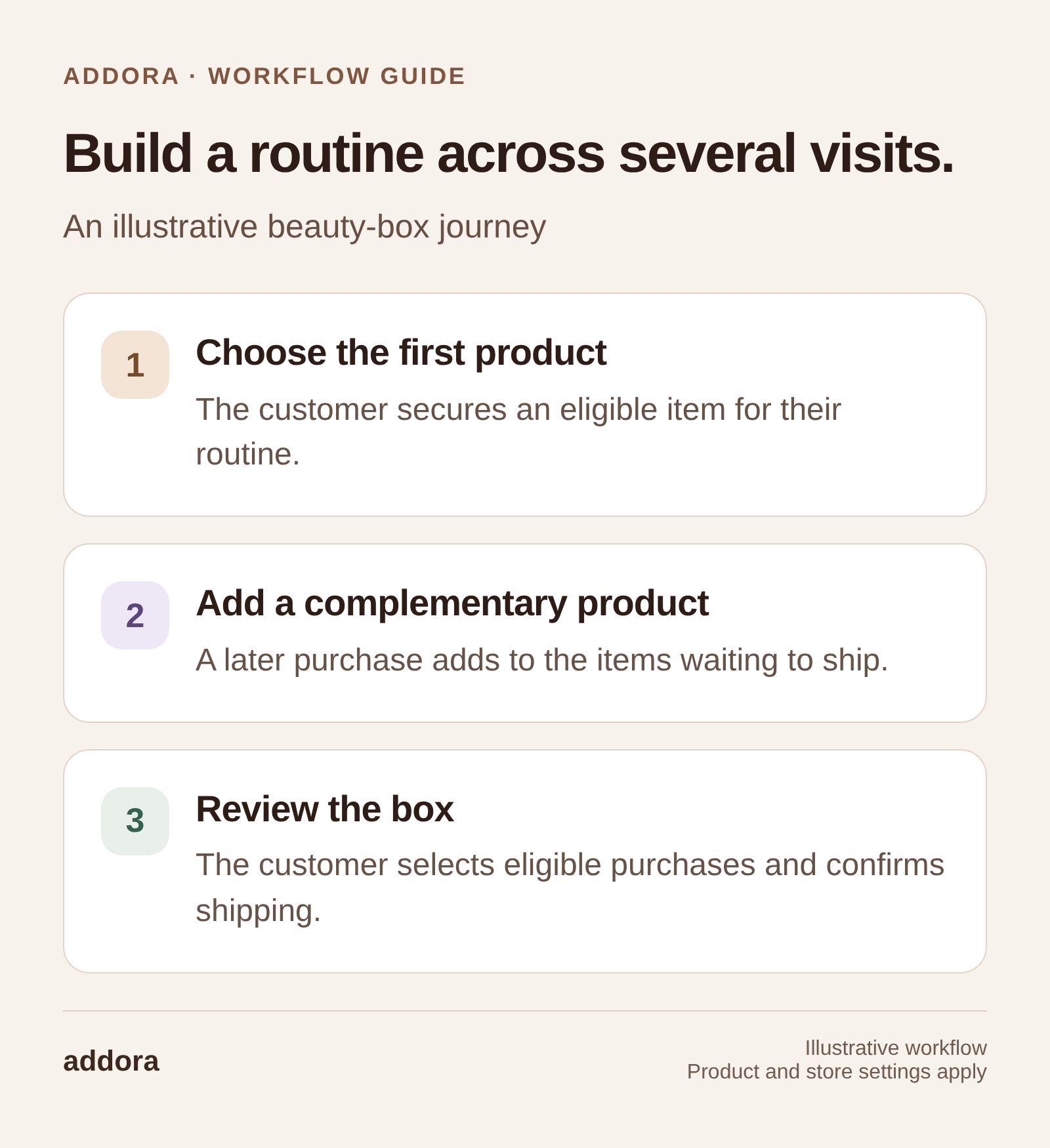
View this workflow at full size
K-beauty is growing fast, but the way people buy it is changing even faster
The macro picture is already big. Grand View Research estimates the global K-beauty products market at $11.56 billion in 2024 and projects it to reach $26.19 billion by 2033. Reuters reported that South Korean cosmetics exports hit a record $10.2 billion in 2024, helped by social platforms and the broader spread of Korean culture, while U.S. imports of beauty and personal care products from South Korea rose 69% in the first ten months of 2024, enough for Korea to overtake France as the biggest exporter of those products to the U.S. market.
That alone is a big story. But the more interesting story, to me, is how demand is now being formed.
Reuters described the category’s export surge as being driven by “social media and the rising popularity of Korean culture.” McKinsey found that 40% of surveyed U.S. beauty consumers made a beauty purchase on social media in 2023, and said beauty buyers are becoming “more willing to experiment and trade up.” Spate’s 2025 K-beauty trend report added another useful signal: K-beauty skincare-related searches were up 43.3% year over year, with cleansing products up 87.3%.
That matters because social beauty discovery does not create one tidy cart. It creates sequences.
A customer sees a trending cleanser. Then comes back for a toner. Then realizes they want the matching SPF. Then gets pulled into a lip product or cushion foundation a few days later.
That is not a one-time purchase pattern. That is routine-building in installments.
K-beauty is not just bought, it is assembled
This is the part I think a lot of stores still underestimate.
K-beauty is especially well suited to repeat buying because the category naturally encourages layering and curation. Customers do not just want a product. They want a routine that feels coherent. One purchase tends to trigger the next one.
A viral serum can lead to an essence. An essence can lead to a moisturizer. A sunscreen can lead to a reapplication mist or a tone-up product. A skincare order can easily become a makeup order on the next visit.
This is why K-beauty stores often feel more like evolving baskets than fixed transactions. The customer is not necessarily trying to buy everything in one sitting. They are building a regimen over time.
And that is exactly where traditional ecommerce shipping starts to feel outdated.
The real friction is not always price, it is shipping timing
Baymard’s checkout research makes the top-line problem obvious: average cart abandonment is 70.22% globally, and among shoppers who were not just browsing, 40% abandoned because extra costs were too high. Another 12% left because they could not calculate the total order cost up front, and 42% said they were just browsing or not ready to buy.
A lot of merchants respond to that with free shipping thresholds, which makes sense on paper.
But in K-beauty, I do not think threshold logic always solves the real issue.
If the customer is close to the threshold, free shipping can absolutely help. But if they only want one cleanser or one serum today, the threshold can feel less like a reward and more like a tax on buying exactly what they came for. The customer is left with three bad options:
- pay shipping again on a smaller order
- add filler items they do not really want yet
- wait until later, and risk the product going out of stock or the momentum fading
That is not a healthy shopping dynamic.
And in a category driven by social discovery, speed matters. If the product is trending now, the customer may want to secure it now, even if they are not ready to finish building the whole routine yet.
This is why I think Build a Beauty Box will become standard
When I think about where K-beauty ecommerce is heading, I do not think the biggest innovation will be another subscription box. I think it will be something more flexible than that.
I think it will be Build a Beauty Box.
By that, I mean a model where the customer can:
- secure a trending product immediately
- keep building their routine across multiple visits
- combine orders into one shipment later
- ship once when the timing feels right
That is a very different behavior from standard checkout.
And importantly, it is different from a traditional subscription. A subscription assumes predictability. Build a Beauty Box assumes discovery. It lets the customer react to trends, launches, seasonal needs, and impulse interest without being punished by repeated shipping decisions.
That feels much closer to how K-beauty customers actually behave.
Why this matters for customers
From the customer side, the upside is obvious.
First, they do not have to miss fast-moving products. If something goes viral or comes back in stock, they can secure it right away.
Second, they do not have to keep paying shipping on small, fragmented orders.
Third, they can build a more intentional routine. Instead of stuffing a cart with backup items or filler products just to make shipping feel rational, they can buy what they genuinely want in the moment and keep shaping the box over time.
That is a better emotional experience too. It turns shopping from “Do I want this enough to justify shipping?” into “Yes, I want this, and I can decide shipment later.”
For K-beauty, that is a big difference. The category is supposed to feel fun, exploratory, and personal. The shipping model should support that, not interrupt it.
Why this matters for merchants
For merchants, I think the opportunity is bigger than just conversion.
A Build a Beauty Box model should help in at least five ways.
1. Higher conversion on trend-led products
If a customer can reserve a product without finalizing shipment immediately, there is less friction around impulse demand. That matters when social trends move quickly and product interest peaks in short windows.
2. More repeat purchasing, without punishment
K-beauty already encourages repeat visits. A smarter shipping model turns those repeat visits into a stronger customer relationship instead of a repeated shipping penalty.
3. Better alignment with how routines are built
Customers do not always know their full basket on visit one. A build-over-time model fits the reality that skincare regimens are often assembled gradually.
4. Fewer low-quality threshold hacks
Stores do not have to rely as heavily on “add one more thing” behavior just to make shipping tolerable. That can lead to cleaner baskets and a more deliberate customer experience.
5. Potentially fewer parcels and more efficient fulfillment
If more orders are intentionally consolidated, that should mean fewer shipments overall and a lower parcel count per customer over time. I would frame that as an operational upside, and in many cases a sustainability upside too.
For the wider packaging context, read our overview of the EU Packaging and Packaging Waste Regulation. The regulation has its own obligations; a flexible shipping workflow alone does not establish compliance.
Why K-beauty is the perfect category for this shift
Some categories can live with traditional checkout forever. I do not think K-beauty is one of them.
K-beauty is too trend-sensitive. Too social. Too discovery-led. Too layered. Too repeat-purchase-heavy.
That combination creates a category where customers often want to say yes to the product before they are ready to say yes to shipping.
And that is why I think Build a Beauty Box will become more than a clever feature. I think it will become the expected shopping model for a meaningful slice of K-beauty ecommerce.
The brands that adopt it early will not just look innovative. They will be aligning their store with how customers already behave.
Where Addora fits
This is exactly the problem we built Addora for.
Addora enables a Build a Beauty Box workflow directly on Shopify. Customers can buy now, hold orders, manage them in a self-serve flow, and ship selected items together when they are ready. The app is built around order combination, build-a-box behavior, and limited-drop workflows, which makes it a strong fit for any beauty store where customers buy across multiple sessions instead of one perfect cart.
I do not think the next major edge in K-beauty will come from making checkout faster in the old model.
I think it will come from making checkout smarter for the new one.
The broader Build a Box guide explains the workflow outside beauty retail. For the customer’s return visit, see how held purchases work inside Shopify customer accounts.
Final thought
There will always be another trending ingredient. Another texture. Another format. Another product wave.
But the deeper shift, the one I think merchants should pay attention to now, is that K-beauty customers are not shopping in one clean moment anymore. They are discovering, collecting, comparing, and building routines over time. The brands that support that behavior will have an advantage.
That is why I believe Build a Beauty Box will be one of the next big shifts in K-beauty ecommerce. And it is exactly why we built Addora.


