
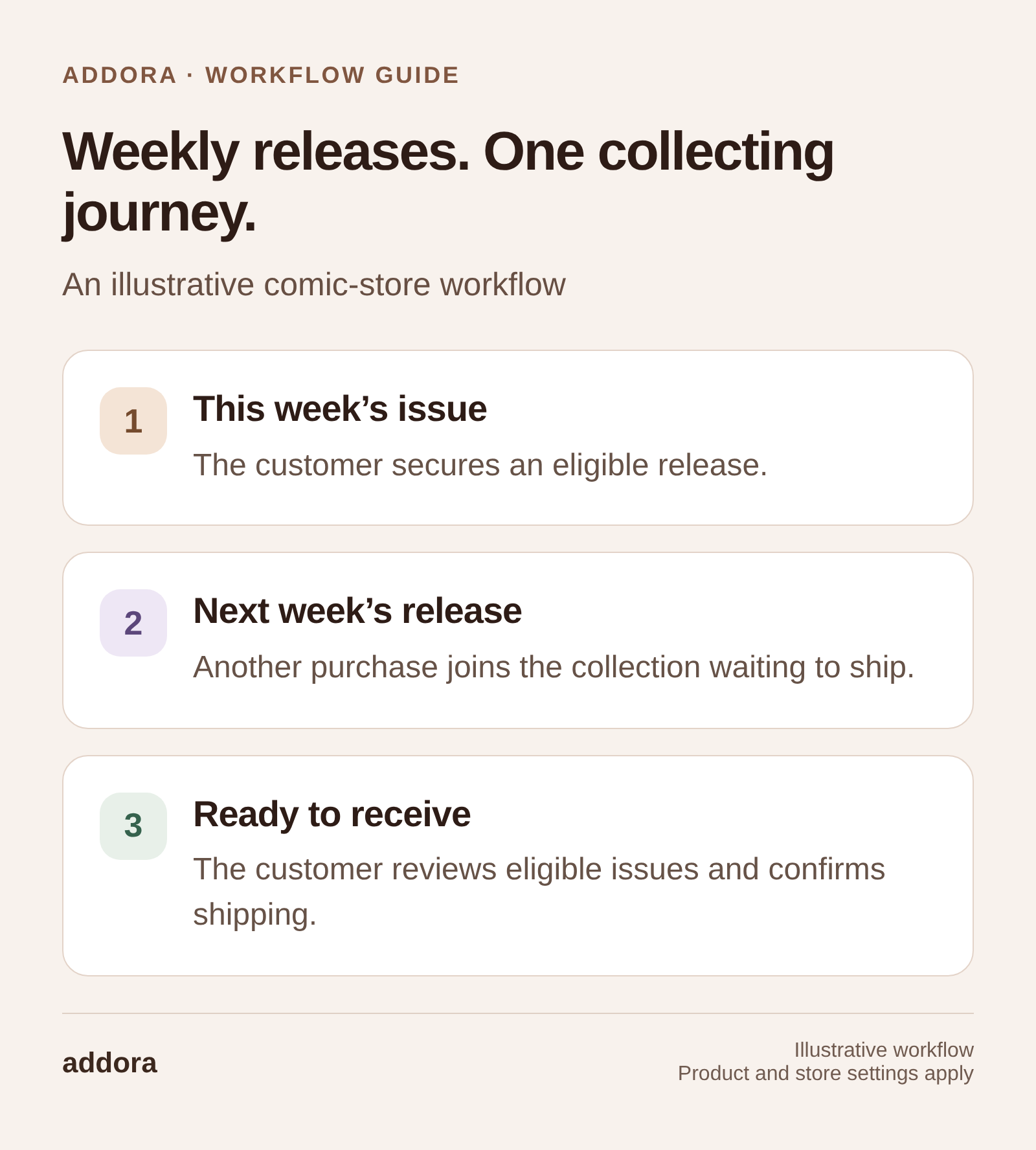
View this workflow at full size
Comic collecting is not a one-purchase behavior
If you sell to comic collectors, you are not selling into a normal “browse, buy, ship, done” pattern.
You are selling into a category built around cadence, continuity, and curation. The modern comic market is not shrinking into irrelevance either. ICv2 says comics and graphic novel sales totaled $1.935 billion in 2024, up 73% versus 2019, and that dollar sales in comic shops rose about 13.3% in 2024. It also reported that sales from January through August 2025 at stores using the ComicHub POS system were up 27% versus the same period in 2024. That is not the profile of a dormant niche. It is the profile of a category with real momentum. (ICv2)
Just as importantly, that growth is not only being held up by aging legacy buyers. ICv2 said retailer interviews pointed to Gen Z arriving in comic shops in record numbers in 2025, and CEO Milton Griepp said new publishing lines were bringing readers into stores in numbers “we haven’t seen in a very long time.” That matters because it means collector behavior is being reinforced by a new generation of shoppers, not just sustained by older habit. (ICv2)
The category trains customers to come back constantly
Comic stores do not operate on a static-product schedule. They operate on a recurring release calendar that conditions customers to return every week.
DC explicitly returned to the traditional Wednesday release rhythm and called it the industry-standard New Comic Book Day that fans look forward to each week. Marvel’s official release calendar for April 22, 2026 showed 15 new releases on sale that day alone, with a dedicated “Show Variants” toggle built into the calendar. In other words, official publisher infrastructure is built around a steady weekly drop cycle and multiple collectible versions of the same issue. (DC)
That weekly cadence matters commercially. It means a collector may want to buy something this Wednesday, then come back next Wednesday, then add a back issue on Friday, then grab a variant cover when it appears. The store is not dealing with one clean buying moment. It is dealing with an ongoing accumulation process.
Variant culture makes the buying pattern even more cumulative
Collectors are not only buying stories. They are often buying editions, covers, print treatments, artist-specific versions, and pieces that complete a set.
Marvel’s own publishing pages make this obvious. Fantastic Four #1 in 2025 was announced with a main cover plus a foil variant, wraparound variant, connecting variant, remastered variant, Retrovision cover, Disney What If? homage variant, Marvel Rivals connecting variant, and more. Separately, Marvel ran a 15-cover connecting variant program across April 2025, with matching Blue Line Sketch versions, and launched a monthly 250th Homage Variant Covers program running from July 2025 through July 2026. These are not fringe extras. They are central to how publishers package desirability and collectibility. (marvel.com)
That means comic buyer behavior is inherently layered. A customer may want the reading copy, the ratio or premium cover, the connecting piece that completes a run, or the issue that fits with a longer theme. They may not be done after one order, even if they are done for the day.
Comics are also a serious collectibles market, not just a reading market
Another reason checkout breaks down for comic collectors is that comics do not sit in a simple “media product” category anymore. They live inside a mature collectibles ecosystem.
CGC describes itself as the definitive leader in comic book certification, offers a population report and registry, and frames graded comics as competitive collectible sets. PSA, best known for grading cards and other pop culture collectibles, expanded into comic and magazine grading in 2025 and called it a “natural progression” of its position in the collector market. Those are strong signals that comics are being treated not just as reading material, but as authenticated, condition-sensitive collectible assets. (CGC Comics)
At the top end, the money is real. In November 2025, Heritage Auctions sold a CGC 9.0 copy of Superman #1 for $9.12 million, setting a new record for the most expensive comic ever sold and beating the prior $6 million record for Action Comics #1. Most customers are obviously not shopping at that level, but the presence of that market still shapes collector psychology. It reinforces scarcity, condition sensitivity, provenance, and the idea that comic books are objects to acquire and hold, not just consume once and forget. (Heritage Auctions)
This is why comic buyers buy over time
Once you put those pieces together, the actual buying pattern becomes obvious.
Collectors buy weekly releases. They chase variants and connecting covers. They fill gaps in runs. They react to story events, creator heat, film tie-ins, and sudden availability. They find a book they were not planning to buy, but do not want to miss.
That behavior is cumulative by nature. The customer often wants to commit to the comic before stock disappears, but does not necessarily want to commit to shipping right now.
That is the key problem with standard ecommerce checkout for comics. It treats every purchase like a final shipment event. For a comic collector, that can feel premature. They may know there is another Wednesday coming in a few days. They may expect another variant to appear. They may want to wait until the bundle feels worthwhile. So they hesitate, postpone, or abandon the order.
The checkout problem is bigger than shipping cost alone
This is where many stores oversimplify the issue.
The problem is not merely that shipping costs money. The deeper problem is that standard checkout forces a decision that does not match the collector’s timing. It asks them to finalize logistics at the exact moment they are still thinking like a collector.
Baymard’s checkout research shows how dangerous that is. Its latest figures put average cart abandonment at 70.19% globally. Among shoppers who were not just browsing, 39% said they abandoned because extra costs were too high, while 14% said they could not calculate the total order cost up front. Those are general ecommerce numbers, not comics-specific, but they map directly onto comic-collector friction. If a customer expects more orders soon, repeated shipping makes each individual order feel less rational. (Baymard Institute)
For comics, that friction often shows up in a very specific way: “I’ll wait until I have more.” And when people wait, some never come back to complete the order at all.
What Addora changes
Addora changes the structure of the decision.
Instead of forcing every comic purchase to become an immediate shipment, it lets customers:
- secure books as they go
- hold orders over time
- ship everything together when they are ready
That is a simple idea, but it aligns much better with how comic collectors actually behave.
A collector who sees a must-have issue can lock it in. A collector who wants to build a stronger bundle can keep adding. A collector who hates paying shipping on multiple small orders can consolidate later.
That is not just a convenience feature. It removes a structural mismatch between collector behavior and standard checkout logic.
To turn that buying pattern into a working policy, use our shipping setup for collectible stores. The Shopify customer accounts guide explains how readers can return to their held issues and choose eligible items to ship.
Why that matters for comic stores
For stores, the upside is bigger than “better UX.”
When you reduce the pressure to ship immediately, you reduce one of the main reasons collectors delay purchases. That can support:
- more completed purchases
- higher accumulated order value over time
- less hesitation around smaller purchases
- better alignment with weekly and event-driven buying
It also lets the store monetize the category more naturally. Comic stores already know that customer intent often stretches across weeks, not minutes. Addora simply gives the checkout layer a way to reflect that.
What we are seeing in Addora merchant data
The strongest proof here is behavioral.
In internal Addora data from comic book stores, the share of orders using “ship later” moved from:
- 3% in month 1
- to 28% in month 2
That is roughly a 9x increase in adoption in one month.
That pattern is important because it suggests this is not a gimmick that customers try once out of curiosity. It looks more like a habit that becomes more valuable as customers understand it. Once collectors realize they can secure books now and consolidate later, usage grows quickly.
That is exactly what you would expect from a behavior-aligned feature. The first reaction is interest. The second is routine.
The bigger shift
Traditional checkout was built around a simple retail assumption: one purchase, one shipment, one finished transaction.
Comic collecting does not work like that.
The category is weekly. It is variant-driven. It is continuity-driven. It is collectible. It is often condition-sensitive. And for many customers, it is cumulative by design.
That is why Addora is such a strong fit for comic book stores. It does not try to force collector behavior into a normal ecommerce model. It adapts the checkout experience to the reality that collectors buy in layers and ship when the moment is right.
Final thought
The comic market today is active, publisher-supported, release-driven, and deeply collectible. Official publisher calendars, variant programs, grading ecosystems, and market data all point the same way: this is not a category where the average customer buys once and disappears. (DC)
So the question for a comic store is not only, “How do I sell this issue?” It is, “How do I let collectors buy the way they already want to buy?”
That is the gap Addora fills, and why it can be a genuine game-changer for comic book collectors and the stores that serve them.
These results describe the customers and period discussed in this article. They are observed comparisons, rather than a controlled experiment or a guarantee of results for another store.


