
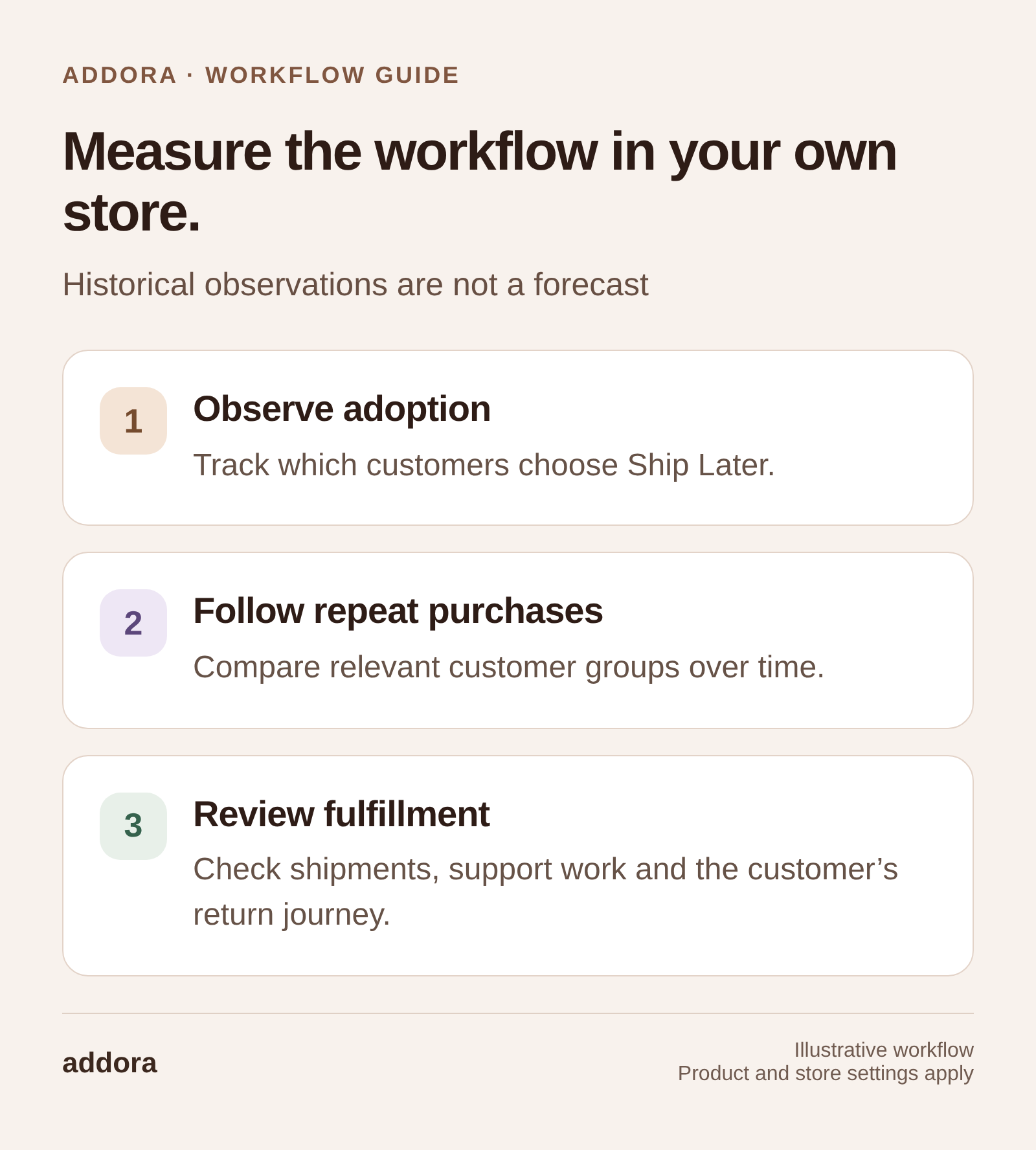
View this workflow at full size
How to read these historical observations
This article describes an earlier observational snapshot of stores using Addora. It is not a controlled experiment, a current benchmark, or a forecast for another store. Customers who choose Ship Later may already be more frequent buyers; differences between groups do not establish that Addora caused additional orders or revenue. Use the figures as historical context and measure adoption, repeat purchases, holding time and fulfillment outcomes in your own store.
For the current product workflow, see Shopify preorders, Ship Later and plans and pricing.
Most ecommerce data tells you what customers bought.
Very little tells you how customers actually want to buy.
That is the interesting part about running Addora across fast-growing collector categories like trading card games and comic books. Because once customers are given the option to consolidate orders, delay shipping, and build larger combined shipments over time, their behaviour starts changing in ways most Shopify stores never get visibility into.
Over the last month, we looked at usage trends across Addora merchants in two particularly passionate collector sectors:
- TCG (Trading Card Games)
- Comic books
And the results show something important:
Customers are not just using Ship Later to save on shipping.
They are fundamentally changing how they shop.
For a longer observation window, compare the four-month Addora data article. Both describe historical merchant activity, not controlled evidence that the workflow caused the reported outcomes.
TCG Stores: Fewer Users, Much Bigger Revenue
The first thing that stood out in TCG was adoption versus revenue impact.
Across TCG merchants using Addora:
- 53% of orders were Ship Later orders
- Around 20% of customers used Ship Later
- Ship Later revenue was almost 2x higher than revenue from regular checkout orders
At first glance, the 20% customer usage figure might sound low.
But that is actually what makes the data so interesting.
Because it means a relatively small portion of customers are driving a disproportionately large amount of revenue through consolidated purchasing behaviour.
This mirrors something many TCG store owners already suspect intuitively:
Their highest-value customers rarely shop in single isolated purchases.
Collectors and players often:
- chase drops over multiple days
- buy singles gradually
- wait for auction results
- combine pre-orders with live inventory
- purchase opportunistically when cards appear
Traditional ecommerce checkout flows are not designed for this behaviour. Every purchase becomes an immediate shipping decision.
Addora changes that psychology.
Instead of customers thinking:
“Do I want to pay shipping again?”
They start thinking:
“I’ll add this to my shipment.”
That mental shift matters.
Because once shipping friction is removed from the purchase decision, customers become more willing to place smaller but more frequent incremental orders.
And over time, those orders accumulate into significantly larger combined baskets.
The revenue data from TCG merchants strongly supports this.
Despite only around one in five customers actively using Ship Later, the revenue generated through those customers was nearly double the revenue generated through standard checkout behaviour.
In other words:
The customers who adopt consolidation become some of the most valuable customers in the store.
Why Collector Categories Behave Differently
Collector commerce behaves differently from traditional retail.
A customer buying a t-shirt usually makes a single decision:
- Do I want this item or not?
But collector categories are continuous engagement ecosystems.
Customers revisit stores repeatedly because:
- inventory changes daily
- scarcity drives urgency
- emotional attachment is high
- discovery matters
- collections evolve over time
This creates a problem for traditional shipping economics.
Frequent low-value orders create:
- abandoned carts
- hesitation
- shipping fatigue
- delayed purchases
- lost impulse buys
Addora effectively turns multiple checkout moments into a single shipping event.
That changes the economics for both the customer and the merchant.
For customers:
- shipping costs feel lower
- purchases feel more flexible
- they can buy opportunistically
For merchants:
- more repeat purchasing behaviour
- larger cumulative baskets
- improved customer retention
- reduced checkout hesitation
TCG merchants appear to be one of the clearest examples of this dynamic so far.
Comic Books: Rapid Month-over-Month Behaviour Change
Comic book stores showed a different but equally fascinating trend.
Instead of immediately high Ship Later dominance, comic stores showed rapid adoption growth over time.
Here is what we observed:
- Month 1: 3% of orders were Ship Later
- Month 2: 28% of orders were Ship Later
- Month 3: 35% of orders were Ship Later
That is a dramatic behavioural shift in only three months.
The important takeaway is not just the final number.
It is the speed of customer habit formation.
Comic book customers appear to learn the workflow gradually:
- first they test it
- then they understand consolidation
- then it becomes part of their normal purchasing behaviour
This makes sense when you consider how comic buying works.
Many comic buyers:
- follow weekly release cycles
- maintain pull lists
- purchase variant covers
- add back issues sporadically
- want to reduce repeated shipping charges
Once customers realise they can accumulate purchases into larger combined shipments, the value proposition becomes extremely intuitive.
The progression from 3% to 35% suggests something important:
Ship Later behaviour compounds over time.
The longer customers are exposed to consolidated purchasing workflows, the more natural it becomes.
The Bigger Pattern Emerging
Across both sectors, we are starting to see a broader pattern emerge.
Customers increasingly prefer:
- flexible fulfilment
- order accumulation
- shipping optimisation
- asynchronous purchasing behaviour
Traditional ecommerce was designed around immediate fulfilment.
But collector commerce increasingly behaves more like:
- a running cart
- a digital pull box
- an ongoing reservation system
That distinction matters.
Because stores that support this behaviour may gain an advantage in:
- customer retention
- repeat purchase frequency
- average customer value
- purchasing flexibility
And importantly, these insights are difficult to observe without infrastructure specifically built around delayed fulfilment and order consolidation.
Most ecommerce analytics tools only measure isolated transactions.
They do not measure the relationship between multiple orders over time.
Addora does.
What Merchants Should Take Away From This
The most important insight from the last month is this:
Ship Later is not simply a shipping feature.
It changes customer purchasing psychology.
The strongest Addora merchants are increasingly treating consolidation as:
- a retention tool
- a customer convenience layer
- a revenue expansion mechanism
- a way to reduce shipping friction without discounting products
And the sectors seeing the strongest adoption so far share common traits:
- passionate collectors
- repeat engagement
- constantly changing inventory
- emotionally driven purchasing behaviour
TCG and comic books are currently among the clearest examples of this trend.
But we believe these behaviours may extend far beyond collector categories over time.
Because once customers experience the ability to buy freely without immediately committing to shipping costs, standard ecommerce checkout starts to feel surprisingly rigid.
The last 30 days of Addora data reinforced one thing clearly:
The future of ecommerce may not be about making customers buy less often.
It may be about letting them ship less often.
These results describe the customers and period discussed in this article. They are observed comparisons, rather than a controlled experiment or a guarantee of results for another store.
To test the pattern in your own store, use our collectible-store shipping framework. The customer accounts guide covers the self-service journey behind held purchases. These guides describe the workflow, not a promise of the historical results above.


