
When we started thinking seriously about cart abandonment, one thing became obvious very quickly: a lot of advice in ecommerce is built for stores that sell one product, in one session, with one clean shipping moment.
That is not how many Shopify stores actually work.
If you sell vinyl, comic books, die-cast, Pokémon cards, trading cards, or other collectible products, your customers do not behave like one-and-done shoppers. They check back. They follow drops. They wait for the next release. They buy a little now, then come back later. In many of these categories, recurring demand is not a side effect. It is the whole model. The numbers make that clear. The RIAA says U.S. vinyl revenues reached $1.4 billion in 2024 on 44 million units, while ICv2 says comics and graphic novel sales hit $1.935 billion in 2024, up 73% versus 2019. Circana also reported that Pokémon became the top toy property in the U.S. in 2025 with $2.5 billion in sales, up 87% year over year.
That matters because it changes what abandonment actually means.
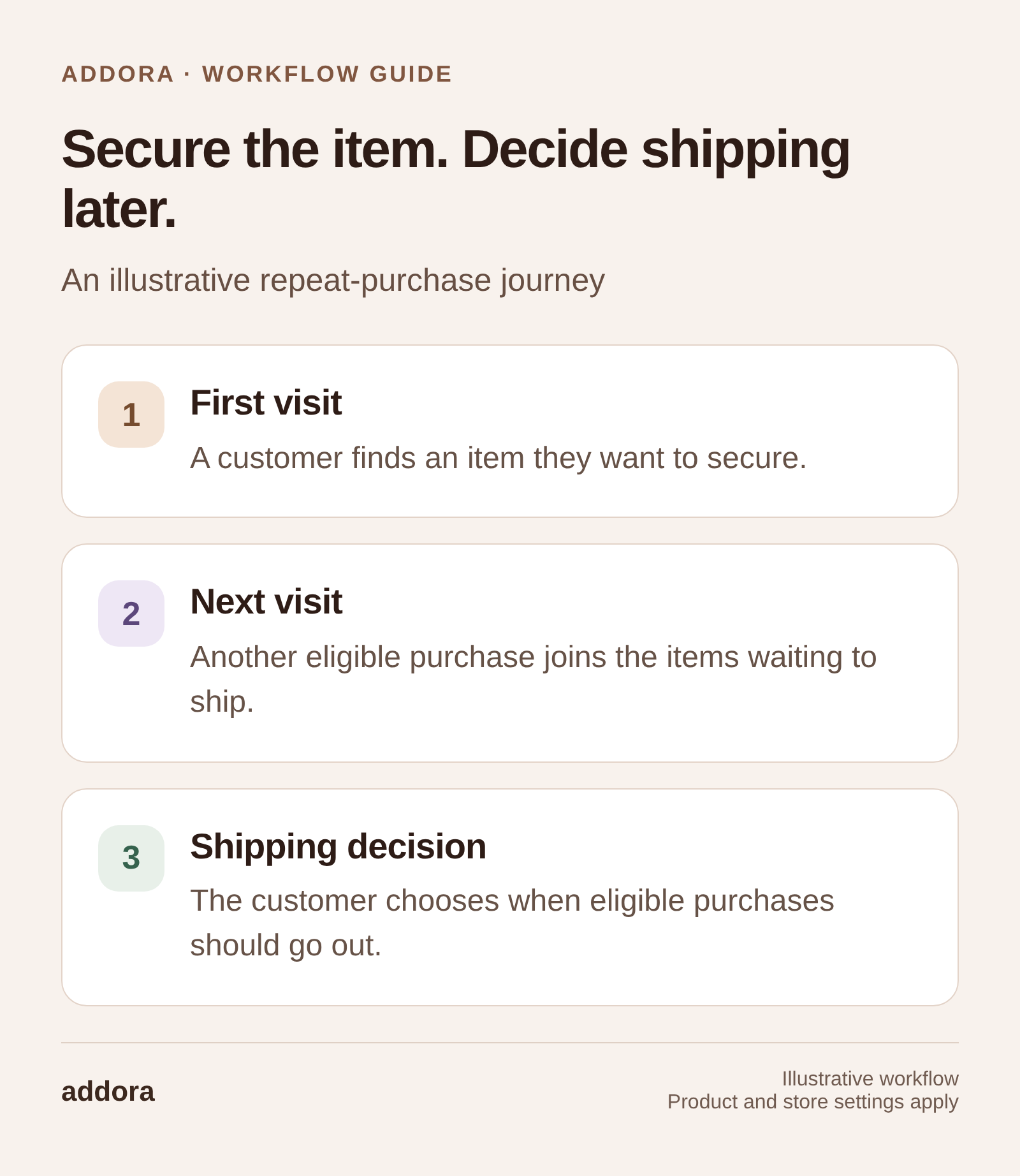
View this workflow at full size
Why shipping fees keep killing checkout
Baymard’s checkout research is still one of the clearest windows into abandonment behavior. Its latest benchmark puts average cart abandonment at 70.22% globally. Among shoppers who were not just browsing, 40% abandoned because extra costs were too high, 20% because delivery was too slow, and 12% because they could not see or calculate the total cost upfront. Those are not minor UX complaints. They are signals that the economics and timing of checkout often break intent right at the finish line.
Most merchants know this, which is why free shipping has become such a standard response. And to be fair, it works, sometimes. A clear threshold can push an order over the line. It can raise average order value. It can make the offer feel cleaner.
But we do not think it solves the whole problem.
Product-page interest and checkout hesitation are connected. Our article on the Shopify conversion gap follows that journey from availability messaging to the shipping decision.
Free shipping does not fix bad timing
What we kept noticing is that free shipping only really works when the customer is close enough to the threshold, and motivated enough, to finish the bundle right now.
That is a narrow condition.
If the customer is far from the threshold, the free shipping offer can feel less like an incentive and more like a reminder that their cart is not “worth enough” yet. If they only want one comic issue, one record, one die-cast, or one pack right now, asking them to pad the order just to make shipping feel rational can create the exact hesitation you were trying to avoid.
Baymard’s data is helpful here again, because it also shows that 42% of abandoners say they were “just browsing / not ready to buy.” In a lot of repeat-purchase categories, I think merchants should read that more carefully. Sometimes “not ready to buy” really means “not ready to ship.” The customer may want the product. They may even fully intend to buy it. They just do not want to pay shipping at that exact moment, because they know there is a good chance they will want more very soon.
That is a very different problem from lack of demand.
Repeat-purchase stores are structurally different
This is the part I think a lot of ecommerce advice misses.
If you run a store where customers buy staples, replacements, or gift items, then the classic checkout playbook makes sense. But if you run a store built around collecting, fandom, curation, and repeated discovery, the customer journey is much less linear.
Vinyl is a good example. The RIAA’s 2024 numbers show the category is not just alive, it is meaningfully large, with vinyl revenue at $1.4 billion. That is not a novelty format. It is a repeat-purchase market driven by collectors, crate-diggers, reissues, limited pressings, and people who come back again and again.
Comics are similar. ICv2’s 2024 market report shows a category powered by ongoing releases, continued demand, and strong comic-shop performance. That is the kind of store where a customer may want this week’s issue now, next week’s issue soon, and a back issue the week after that.
Trading cards and collectible toys show the same pattern. Circana’s reporting on 2025 called out “licensed, collectible, and fandom-driven toys” as outperforming, and said adults 18+ were the fastest-growing toy demographic earlier in the year. In other words, these are not categories where people simply make one rational, isolated purchase and disappear. They are categories where people keep returning to the shelf.
Once you understand that, the limitation of threshold-based free shipping becomes much easier to see. The customer is not failing to complete the session because they dislike your products. They are often hesitating because checkout is forcing them to make a shipping decision too early.
The real friction is shipping timing
That is the insight that led us to Addora.
Traditional ecommerce asks the customer to do three things at once:
- decide they want the item
- decide they want to complete the purchase
- decide they want to ship everything right now
In a repeat-purchase store, those are not always the same decision.
Someone may be fully ready to say yes to the first two, but not the third. They want the product secured. They do not want to lose it. But they would rather wait until they have built a more satisfying bundle before they pay for shipment.
When we looked at the problem that way, “cart abandonment” started to feel like the wrong label in many cases. What looked like abandonment was often just unresolved timing.
What Addora changes
Addora changes the structure of the decision.
Instead of forcing the customer into a buy-now, ship-now flow, Addora lets them buy now and ship later. They can purchase items over multiple sessions, keep those orders pending, and then decide when they want selected items shipped together.
That changes the checkout psychology in a few important ways.
First, it removes the pressure to add filler items just to make shipping feel worthwhile. Second, it lets the customer buy the thing they actually want, when they want it. Third, it turns future sessions into a continuation of the same shipment story, not a new shipping penalty every time.
For the right store, that is a much better match for how customers already behave.
For stores built around repeat purchases, the Build a Box model shows how buying can happen across visits. Our Addora setup guide explains what to configure and test before offering that choice at checkout.
Why we think this works better than just chasing threshold optimization
I am not against free shipping. It has its place. Clear thresholds can still be useful, especially when they are close, credible, and easy to understand.
But if your store lives on repeat visits, small-batch orders, collecting behavior, or drop-driven demand, free shipping alone is often just a partial fix. It tries to persuade the customer to buy more right now. It does not solve the more fundamental problem that the customer may not want to ship right now.
Addora solves for timing instead of only solving for cart size.
That is why I think it is a more interesting tool for stores with repeat-purchase dynamics. It respects the fact that customers do not always build the “perfect cart” in one sitting. Sometimes they want to reserve now, keep shopping later, and ship when the timing feels right.
The shift we care about
The change we want is simple.
We want to move the customer from:
- “I’ll wait until I have enough”
- “I’m too far from free shipping”
- “I don’t want to pay shipping again already”
to:
- “I’ll take this now”
- “I can add more later”
- “I’ll ship when I’m ready”
That is a better experience for the customer, and in a lot of stores, it is a better revenue model for the merchant too.
Final thought
Cart abandonment is real, but it is not always what it looks like.
Yes, extra costs are one of the biggest reasons shoppers leave checkout. Baymard’s data is very clear on that. But in categories built around repeat purchases and collecting, the deeper issue is often not just the cost of shipping. It is the timing of shipping.
That is why we built Addora.
Not to replace every free shipping strategy, but to give repeat-purchase stores a better way to handle the moment where customer intent is real, product demand is real, and traditional checkout still gets in the way.


