
We built Addora because we kept seeing the same thing at checkout. A customer wants the item, gets all the way to the end, and then hesitates because shipping changes the economics of the order. Baymard’s checkout research shows how serious that problem is: average cart abandonment sits at 70.22% globally, and among shoppers who were not just browsing, 40% left because extra costs were too high while 12% left because they could not calculate the total cost upfront. That is the problem space we wanted to solve. (Baymard Institute)
The issue, as we see it, is that most checkouts still force two decisions into the same moment. The customer has to decide whether they want the product and whether they want to ship everything right now. In a lot of stores, those are not naturally the same decision. Someone might be fully ready to secure the product, but still want time to keep building a box, wait for the next drop, or combine more orders before paying for shipment.
That is why we built Addora.
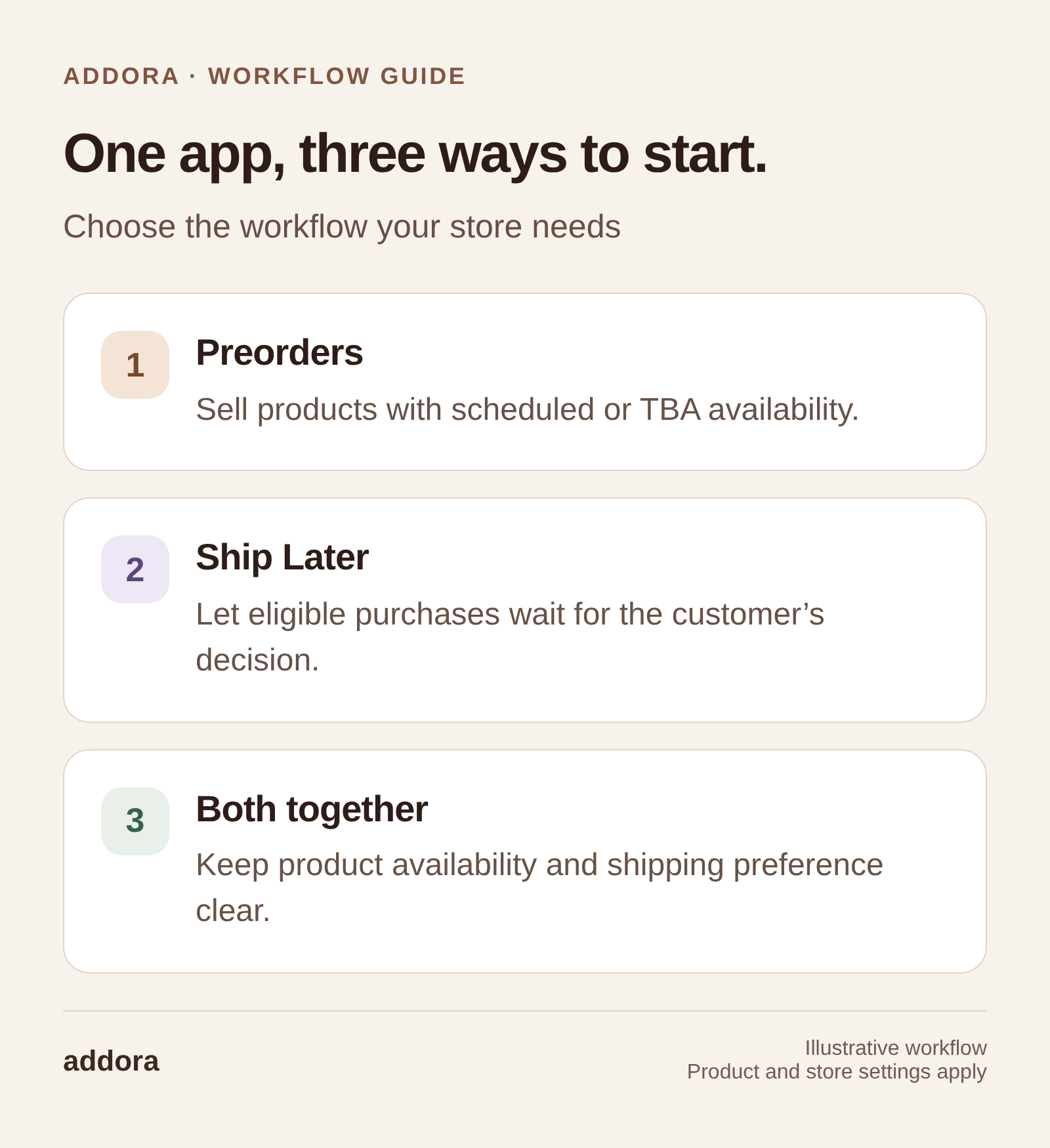
View this workflow at full size
Why this matters now
We think this matters more now because more categories are starting to behave like repeat-purchase, fandom-driven, build-over-time businesses.
Circana reported that in early 2025, adults aged 18+ were the fastest-growing toy demographic, up 12%, with $1.8 billion in spending, and later reported that Pokémon became the top toy property in the U.S., generating $2.5 billion in sales, up 87% year over year. Circana’s own summary pointed to “licensed, collectible, and fandom-driven toys” as leading growth drivers.
We see the same pattern in comics. ICv2 says comics and graphic novel sales reached $1.935 billion in 2024, up 73% versus 2019, with comic-shop sales up about 13.3% in 2024 and ComicHub store sales up 27% through August 2025 versus the previous year. Those are exactly the kinds of categories where customers do not buy once and disappear. They come back, collect over time, and often want to delay shipment until it actually makes sense.
That is the broader shift we built Addora for. More merchants now sell into buying behavior that is cumulative. Standard checkout still assumes one order should immediately become one shipment. We think that assumption is too limiting for a lot of modern Shopify stores.
What we built
We built Addora to let merchants offer a Buy Now, Ship Later flow directly in Shopify.
On the Shopify App Store, Addora is described very simply: shoppers can buy now and ship later, combine orders into one delivery, and use the app for build-a-box and limited-drop experiences. Customers place multiple orders over time while shipping stays on hold, then visit the Order Summary page to choose which orders to ship and receive one combined delivery. Merchants can also configure fees, discounts, or free shipping conditions by value, weight, and quantity. (Shopify App Store)
That is the core of the product. We wanted a customer experience that feels intuitive and a merchant experience that does not add unnecessary operational complexity. Customers can secure the product when they want it. Merchants can still manage shipment in a structured way. And because the decision to buy is separated from the decision to ship, the store is no longer forcing customers into an all-or-nothing checkout moment.
What makes the flow practical
For us, the idea only matters if it works in a real store.
That is why the app is built around concrete merchant controls, not just the headline concept. The Shopify App Store listing shows Addora works with Checkout and Shopify Admin, lets merchants offer Ship Later at checkout, lets customers choose which orders to ship from the Order Summary page, and includes an option to edit eligible orders to Shipping Pending if a customer checks out incorrectly. The app also lets merchants customize their own conditions for fees, discounts, and free shipping. (Shopify App Store)
We cared a lot about that part. It is easy to describe a concept that sounds attractive in theory. It is much harder to make it operationally useful. Our goal with Addora has always been to make Buy Now, Ship Later feel like a natural extension of a merchant’s store, not a strange extra layer bolted on top.
Start with the Addora installation guide to choose the right workflow. If release dates are part of your catalog, the native Shopify preorder setup guide explains how availability fits alongside Ship Later.
Who we built it for
We built Addora for merchants whose customers buy in sequences rather than one isolated burst.
That includes stores with free-shipping thresholds, stores with high repeat-purchase behavior, stores shipping internationally, and stores selling products that are collected, accumulated, or discovered over time. Build-a-box stores, limited-drop stores, comics, trading cards, vinyl, toys, hobby products, and other small-item businesses are all obvious fits.
The common thread is simple. The customer often wants to secure the item now, but would rather wait to ship until they have built something more worthwhile.
What early feedback tells us
We launched Addora on the Shopify App Store on February 9, 2026. The current listing shows pricing from $12/month, a free trial, and a 5.0 rating. Early feedback is limited but encouraging. One merchant review called Addora a “game changer” for stores shipping internationally and said they were surprised it was “the only one” they had found that lets customers combine multiple orders into a single shipment. (Shopify App Store)
That kind of feedback matters to us because it gets to the heart of why we built the product. We are not trying to create fake urgency or paper over checkout friction with a cosmetic tweak. We are trying to solve a real structural problem: customers often want the product before they want the shipment.
Why we believe in this model
What we believe, very simply, is that shipping timing is often a bigger part of conversion than merchants realize.
A lot of customers are ready to say yes to the item. They are just not ready to say yes to shipping yet. And in stores where people buy repeatedly, that mismatch becomes expensive. Some customers wait until they have more. Some delay and forget. Some decide the extra shipping is not worth it. All of that suppresses conversion in ways that are easy to underestimate.
We built Addora because we think merchants deserve a better option than trying to solve that only with threshold bars, shipping discounts, or checkout nudges. Those tools can help, but they still keep the same basic structure in place. Addora changes the structure itself.
If the terminology sounds familiar, our Buy Now Ship Later versus Buy Now Pay Later guide explains why postponing shipping is different from postponing payment.
Final thought
We built Addora around a simple idea: let customers secure products now without paying shipping over and over again.
Baymard’s data shows how often shipping costs and unclear totals break checkout. The growth of collectible and repeat-purchase categories shows why this problem is becoming more visible. And our Shopify App Store listing reflects the product direction clearly: Buy Now, Ship Later, order combination, build-a-box support, flexible shipping conditions, and one combined delivery when the customer is ready. (Shopify App Store)
That is why we built Addora, and why we believe Buy Now, Ship Later has a real future on Shopify.


