Most merchants trying to stop Shopify split shipping are not really trying to solve one problem. They are usually trying to solve one of three: checkout confusion, inflated shipping charges, or operational fulfillment chaos.
That distinction matters, because Shopify handles checkout presentation, shipping-rate logic, and fulfillment routing as separate layers. If you treat them like one switch, you can spend hours changing settings and still end up with a messy customer experience.
If you sell both preorders and in-stock items, this is one of the most common traps in Shopify. A customer builds one cart, expects one clean checkout, and suddenly the order is being treated like multiple shipments. Sometimes that is exactly the right behavior. Very often, it is not.
This guide explains what Shopify split shipping actually is, when it is working as intended, when it creates unnecessary friction, and how to decide whether you should reduce it, accept it, or replace it with a different order flow entirely.
View this workflow at full size
What Shopify split shipping actually means
Shopify can treat one cart as multiple shipments when the products in that cart cannot be fulfilled together in one simple shipment.
That can happen for a few different reasons:
- preorder and in-stock items are mixed in the same cart
- products belong to different shipping profiles
- products are stocked in different locations
- subscription or special fulfillment logic applies
- Shopify routing determines the order cannot be fulfilled cleanly from one place
This is why merchants often get confused. They assume the issue starts and ends with preorders, but preorders are only one trigger. A mixed cart can behave strangely because of shipping profiles, inventory setup, or location routing just as easily.
So before you try to "turn off split shipping," it helps to ask a more honest question:
What exactly am I trying to stop?
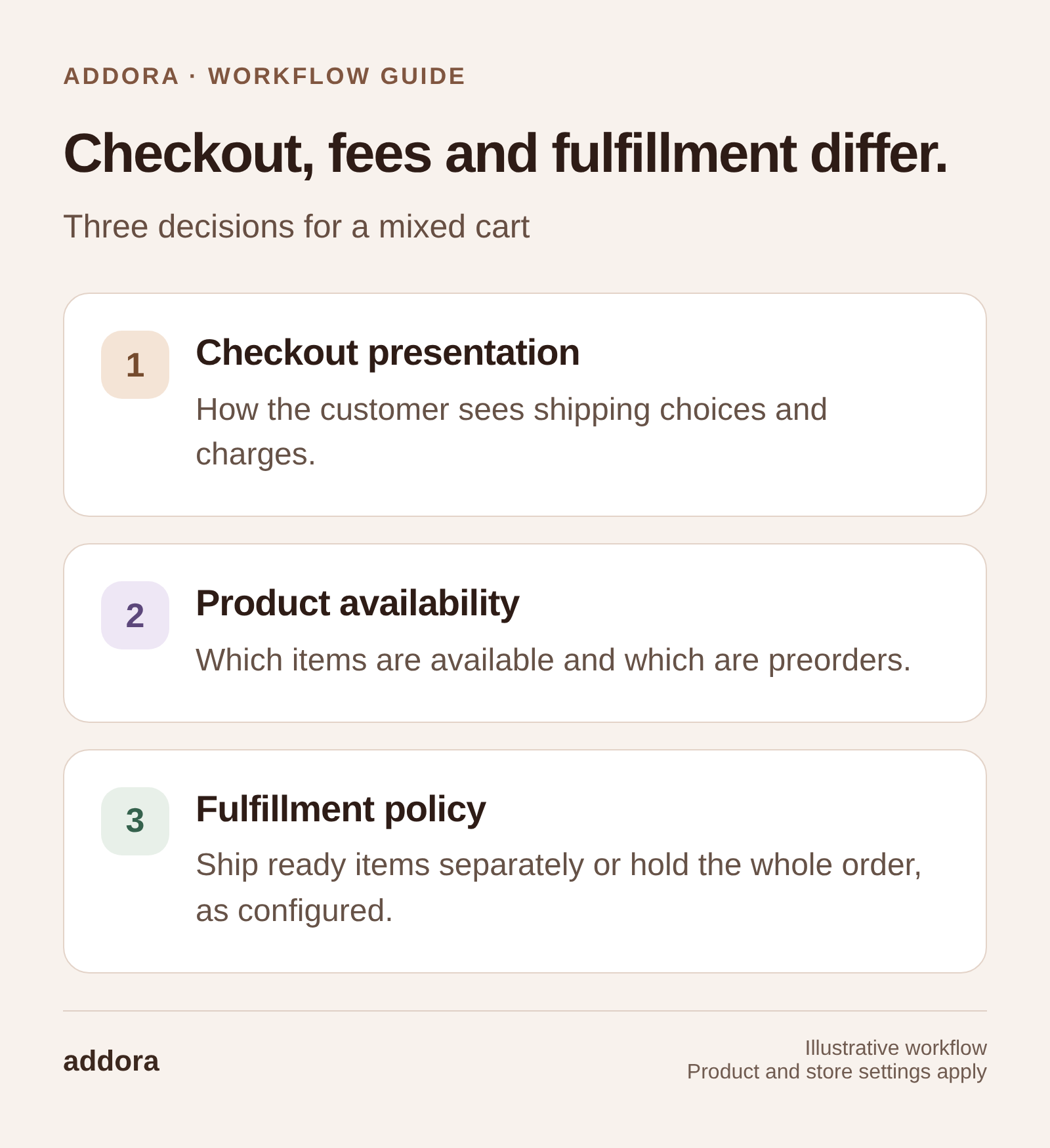
The three problems merchants usually mix together
When merchants say they want to stop split shipping, they are usually talking about one of these three problems.
1. Checkout presentation
They do not want customers seeing multiple shipments or multiple delivery choices when the customer expected one clean order.
2. Shipping charges
They do not want mixed carts to create confusing totals, stacked shipping rates, or the feeling that Shopify is charging twice for shipping.
3. Fulfillment operations
They do not want staff dealing with split fulfillment, manual holds, refund workarounds, or support tickets after the order has already been placed.
These problems are connected, but they are not the same. That is why so much advice on this topic ends up being half useful at best.
When split shipping is actually the right choice
Not every store should try to suppress split shipping.
If your business model is "ship in-stock items now and send preorder items later," then split shipping is not necessarily the enemy. In that case, it can actually be the most honest customer experience.
Instead of hiding the tradeoff until after payment, checkout makes it visible upfront. The customer can see that part of the order is available now and part of it is delayed. That may create a little more friction in checkout, but it avoids a lot of confusion later.
For some stores, that is the correct outcome.
If this is how you want orders to move, your job is not to fight split shipping. Your job is to make it easier to understand by improving lead-time communication, cleaning up shipping profiles, and making sure your product pages set the right expectation.
When merchants usually want to reduce split shipping
A lot of stores do not want in-stock items to go out separately from delayed items.
They want one shipment later, once everything is ready.
This is common in stores with:
- preorders
- collectibles
- hobby products
- limited drops
- build-a-box flows
- repeat-buyer behavior where customers prefer to stack purchases
In that case, the real goal is not "split less." The real goal is "keep the order together."
That leads to a very different setup.
How to reduce split shipping in native Shopify
If your goal is to keep preorder and in-stock items together and send one shipment later, native Shopify can help, but only if the rest of your setup supports that goal.
Turn off visible split shipping where appropriate
If your store setup allows it, reducing or disabling split shipping in checkout can stop customers from being forced into thinking about multiple shipments before they pay.
That helps with the presentation side of the problem.
It does not automatically fix fulfillment logic, shipping-rate design, or location complexity. It just reduces one layer of friction.
Reduce shipping-profile complexity
Separate shipping profiles are often the hidden cause of confusing checkout behavior.
Many merchants think they have a preorder problem when they actually have a shipping-profile problem. If products are split across profiles unnecessarily, Shopify may combine or separate rates in ways that make checkout feel inconsistent.
If you want one clean order flow, simplify profiles as much as you reasonably can.
Review your fulfillment locations
If too many locations are allowed to fulfill online orders, Shopify may be forced into routing patterns that increase the chance of split fulfillment.
This does not always show up clearly to the merchant at first. On the surface it can look like a checkout issue, when really it is inventory fragmentation.
If your operational policy is "keep orders together," then location setup matters a lot.
Use fulfillment holds when the whole order should wait
This is one of the most important points, and it is the one most articles skip.
If your actual business rule is "do not ship until the full order is ready," then fulfillment holds are often more important than checkout settings.
A clean hold policy prevents your team from accidentally treating mixed carts like they should move immediately just because part of the order is available.
Be extremely clear about preorder timing
You can reduce a surprising amount of friction just by explaining what will happen.
If a product is delayed, say so clearly on the product page. If mixed orders are held until everything is ready, say that too. The more transparent your policy is before checkout, the less likely customers are to interpret normal behavior as a store mistake.
What native Shopify does not solve especially well
There is one goal that native Shopify does not handle elegantly on its own:
Letting customers keep buying over time, stack orders, and decide later when everything should ship together.
That is not really a classic split-shipping problem.
It is a hold-and-release flow problem.
This is where many merchants waste time. They start by tweaking shipping profiles or checkout settings, hoping Shopify can be persuaded into acting like a customer-controlled order holding system. Usually that only gets them halfway there.
If your real promise is:
- keep shopping
- we will hold your orders
- release everything into one shipment when you are ready
then you are not really looking for a nicer shipping setup.
You are looking for a different order flow.
That is why the Shopify ecosystem ends up with separate categories of apps for preorders, order merging, shipping holds, and stacked fulfillment workflows. These are adjacent problems, but they are not identical.
The mistake most merchants make
The most common mistake is trying to solve a policy problem with a checkout setting.
If your store policy is:
- ship in-stock items immediately
then split shipping may be correct.
If your store policy is:
- hold the whole order until everything is ready
then fulfillment holds, location setup, and profile simplification matter more.
If your store policy is:
- let customers keep ordering and choose later when to ship
then you probably need a dedicated hold-and-release experience, not just a tweak to checkout.
That is the part merchants often realize too late.
A better decision framework for mixed carts
For most stores, this is the cleanest way to decide what to do.
For the operational workflow after checkout, see shipping ready items while holding the rest. If the goal is to consolidate purchases from several orders, use the combined shipping guide alongside your mixed-cart policy.
Use native split shipping if:
- you want available items to leave now
- you want delayed items to ship later
- you are comfortable making that visible in checkout
- you prefer fewer post-purchase support issues, even if checkout is a little more complex
Reduce or disable visible split shipping if:
- you want one shipment later
- you are happy to delay the full order until everything is ready
- your customers value simplicity more than immediate partial shipment
- your operations are built around holding mixed orders
Use preorder or deposit tooling if:
- your real problem is commitment, cash flow, or forecasting demand
- you need better preorder communication and structure
- you want customers to reserve demand before stock arrives
Use a dedicated hold-and-release flow if:
- you want customers to keep buying over time
- you want them to decide later when to ship
- you want to avoid manual order merging and support-heavy workarounds
- you are trying to create a real buy-now-ship-later experience
The best angle for most merchants
Most merchants researching this topic do not need another article that says "go into settings and flip a toggle."
They need someone to tell them the truth:
- sometimes split shipping is correct
- sometimes it should be hidden
- sometimes it is a symptom of a messy setup
- sometimes it should be replaced with a completely different order flow
That is the real decision.
Once you see it that way, the topic gets much easier.
Final take
The best way to stop Shopify split shipping is usually not to obsess over the phrase itself. It is to decide what customer and operational behavior you actually want, then configure Shopify around that behavior.
If you want separate shipments, lean into native split shipping.
If you want one shipment later, simplify locations, reduce shipping-profile complexity, and use fulfillment holds.
If you want a true buy-now-ship-later experience, stop treating it like a checkout-toggle problem. It is a customer-flow problem, and the stores that understand that tend to create a much cleaner experience.
Want a true buy now, ship later flow?
If your customers want to keep buying over time and choose later when everything ships together, native Shopify usually starts to feel awkward pretty quickly.
That is the gap Addora is built for.
Addora helps merchants offer a real buy now, ship later experience on Shopify, so customers can keep adding to their box without forcing your team into manual order merging, refund workarounds, or confusing shipping logic.
If that is the model you want to offer, check out Addora and see how a proper ship-later flow feels in practice.
Sources and further reading
- Shopify Help Center: Split shipping in Shopify Checkout
- Shopify Help Center: Calculating shipping rates from different shipping profiles
- Shopify Help Center: Shipping profiles
- Shopify Help Center: Understanding order routing
- Shopify Help Center: Setting up order fulfillment for locations
- Shopify Help Center: Managing pre-orders
- Shopify Help Center: Setting up pre-orders
- Shopify Community: Customer option to hold shipping and combine orders when ready to ship
- Shopify App Store: Pre-order apps
Addora’s current preorder and partial-release options
Addora now supports native Shopify preorder purchase options on supported storefront surfaces, with full product payment at checkout and scheduled or TBA availability. Choose Preorders only to retain normal shipping at checkout, Ship Later only for customer-led holds, or both. A second preorder app is not a prerequisite for this setup.
For mixed orders, keep the purchase promise separate from readiness. Eligible ready items can be selected for release while waiting items remain held, subject to store settings and the fulfillment setup. Selection uses the available item quantity shown; it is not an arbitrary quantity picker. Some orders still need to remain together.
A release can result in more than one package. Tracking should match the fulfilled items and packages, while the remainder stays waiting. This does not override Shopify shipping profiles, location routing or fulfillment restrictions.
Read the native preorder setup guide, partial-arrival guide and supplier stock workflow for the corresponding setup decisions.